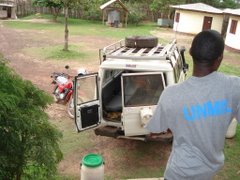
Most Travel, and certainly the rewarding kind, involves depending on the kindness of strangers, putting yourself into the hands of people you don’t know and trusting them with your life. This risky suspension of disbelief is often an experience freighted with anxiety. But what’s the alternative? Usually there is none.
~ Paul Theroux
There was no alternative for me in Sarajevo, until I met Verijan. There was no alternative for me in Nigeria, until I met Justus. There was no alternative for me in Kenya, until I met Henry. There was no alternative for me in Cario, until I met Nader. There was no alternative for me in Yangon, until I met Htaik and Hazlitt. In between such encounters I have been lucky enough to meet dependable taxi drivers in Sierra Leone, thoughtful guest house owners in Thailand, willing direction givers in the labyrinth alleys of Marrakesh, and helpful unsolicited translators all over the planet. This is not to say that I haven’t been robbed, swindled, cheated, or conned but, it is these experiences of angst that allow us to truly celebrate the kindness of strangers when we are at our most vulnerable.
I have not posted in a while. I’m not exactly sure why, but I have returned to share with those loyal readers who keep checking in only to find silence on the screen, what has been on my mind. What I have been thinking about since I returned from the unspoken place has been the listener-storyteller relationship. In my projects in West Africa and South East Asia I have learned much about being human and acting humane. Listening to survivors stories in these places has been painful but it has also been bearable because each and every story teller I have encountered was able to teach a lesson about survival and healing and it appeared the simple act of telling was reparative.
One Bosnian doctor explained this aspect of the listener-storyteller relationship in Mollica’s book Healing Invisible Wounds:
Whenever you tell a story you feel better. I will give you an example of the Bosnian people from the Muslim religion. They do not cry too much. The females go to the funerals and they speak a lot. They repeat and repeat the story. I have had a chance to listen to this several times in several tragic stories on many occasions. They stories are like a tape with the same words and sentences. And each time before they finish, the storyteller is much happier than before, and the listener becomes wealthier from receiving new knowledge. (Mollica, 2006)
The repetition of the story makes the storyteller more comfortable and in effect having listener is part of the therapeutic process. Many of my students, both graduate students from DU as well as community advocates and passionate volunteers in the field, ask me the same question after learning about trauma, PTSD and it’s impact on human functioning.............They told me their story, now what? This is the inevitable next question a counselor/therapist will ask after they are able to build enough trust to be gifted the trauma story of a survivor. Helpers want tools to “fix” the problems and the reality is that there is no magic wand, no super pill and no scientific procedure that can fix a wounded soul other than to honor the fact that they have lived to tell their story. I agree with Mollica when he says that “listeners need to remember that the inherent purpose of trauma stories is healing and survival. Survivors must be allowed to tell their stories in their own way” and “We must not burden them with theories, interpretations, or opinions, especially if we have little knowledge of their cultural or political background. “ Storytelling is in fact a healing art and listening is as growth promoting as telling if we just have patience and are able to integrate both the pain of the trauma sufferer as well as power of the survival tale.
Showing posts with label trauma. Show all posts
Showing posts with label trauma. Show all posts
Sunday, August 8, 2010


Thursday, April 19, 2007
Communication Nuances
I continue to hesitate to capture the nuances of my life here because even though I am living in an English speaking environment I am missing much. If I were to be completely honest I am probably catching about 17% of what is being said. The problem with this is simple: we are speaking the same language – English is Liberia’s national language and everybody here seems to be catching about 72% of what I am saying. This means I can’t ask for a translation; and, one can only say “what?” and “pardon?” so many times before it starts irritating people. At this point I can speak exactly three words in Pelle (the native language for approximately 3 of the 16 Liberian tribes) - Ga a yaillu? (“how much?”) sa na la ma (“show me something”) and am ple (“my stomach is satisfied”). At the end of the day I am left communicating in a fog of incomplete sentences and collective sures and head nods to unknown requests.
The language barrier means I pass the hours ruminating on oblivion – which takes up a surprising amount of time and is something we in the States chronically avoid due to what I believe is a constant state of over-stimulation. Between I-Pods, TVs, cell phones, the internet and golf we are able to be ‘doing” something at all times. Ruminating is left to bride-to-bes who are having a difficult time with soon to be in-laws or table arrangements.
Although there are times it is quite the ego boost to be so recognizable and treated like celebrity, it is not easy. Some people I encounter are looking for a “sponsor.” Sponsor means please give me some money for ________. The requests include payment for everything from school fees to a trip to America or the attainment of a cell phone. Others simply ignore me. Just when I’m feeling disenchanted, different, out of place or unhelpful I have an encounter with a sour-faced adolescent who knows Gwen Stefani or some other pop musician from America. These boys can typically dance to our music with unprecedented grit and grace. I also occasionally meet a well spoken community member who simply wishes to chat. They are all impressed with my ability to sweat and turn instantly pink in this sweltering heat that is sub-Sahara Africa and they often get a kick out of the fact I prefer to walk (rather than ride in the land cruiser) when given the chance.
The psychological wounds are complicated and complex. Many of the women in our groups have survived 3 Liberian wars over the course of 14 years and their children are adjusting to peace rather than warfare. It is not uncommon to hear that women and children were captured by rebel agents and used for forced farm labor or worse. One woman noted that she tried escaping into the bush on multiple occasions. When caught she was forced to watch the killing of her fellow escapees. Most Liberians eventually managed to cross the borders into Sierra Leone or Guinea or went to Monrovia in the late 90s, navigating their way through the bush. Everybody I have met has lost at least one immediate relative and many adolescents are orphans living on their own. People are now returning to their home villages, many with memories of having tried this before only to be welcomed by a new rebel contingent that captured everybody and put them in slave or rape camps. Rebels frequently beat young boys or conscripted then as child soldiers and currently the roads are lined with ex combatants who are being given money and work by a UNICEF reintegration/reeducation program. Most families are still separated with some members living in Monrovia looking for work with all the international NGOs while others remain and work in the local rubber and palm farms.
The language barrier means I pass the hours ruminating on oblivion – which takes up a surprising amount of time and is something we in the States chronically avoid due to what I believe is a constant state of over-stimulation. Between I-Pods, TVs, cell phones, the internet and golf we are able to be ‘doing” something at all times. Ruminating is left to bride-to-bes who are having a difficult time with soon to be in-laws or table arrangements.
Although there are times it is quite the ego boost to be so recognizable and treated like celebrity, it is not easy. Some people I encounter are looking for a “sponsor.” Sponsor means please give me some money for ________. The requests include payment for everything from school fees to a trip to America or the attainment of a cell phone. Others simply ignore me. Just when I’m feeling disenchanted, different, out of place or unhelpful I have an encounter with a sour-faced adolescent who knows Gwen Stefani or some other pop musician from America. These boys can typically dance to our music with unprecedented grit and grace. I also occasionally meet a well spoken community member who simply wishes to chat. They are all impressed with my ability to sweat and turn instantly pink in this sweltering heat that is sub-Sahara Africa and they often get a kick out of the fact I prefer to walk (rather than ride in the land cruiser) when given the chance.
The psychological wounds are complicated and complex. Many of the women in our groups have survived 3 Liberian wars over the course of 14 years and their children are adjusting to peace rather than warfare. It is not uncommon to hear that women and children were captured by rebel agents and used for forced farm labor or worse. One woman noted that she tried escaping into the bush on multiple occasions. When caught she was forced to watch the killing of her fellow escapees. Most Liberians eventually managed to cross the borders into Sierra Leone or Guinea or went to Monrovia in the late 90s, navigating their way through the bush. Everybody I have met has lost at least one immediate relative and many adolescents are orphans living on their own. People are now returning to their home villages, many with memories of having tried this before only to be welcomed by a new rebel contingent that captured everybody and put them in slave or rape camps. Rebels frequently beat young boys or conscripted then as child soldiers and currently the roads are lined with ex combatants who are being given money and work by a UNICEF reintegration/reeducation program. Most families are still separated with some members living in Monrovia looking for work with all the international NGOs while others remain and work in the local rubber and palm farms.
Subscribe to:
Posts (Atom)