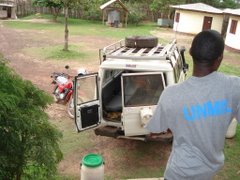
It was Christmas and I had nothing to do. I was hoping to sleep in but the three gentlemen who came to fix my fence squelched that idea. It was 6:22 and I was roused awake by the sound of them pounding nails directly in front of my window. I grabbed my Zune, made some coffee and transitioned out to my hammock.
My divine hammock, gifted to me to from a staff member in Gbarnga, is presently hanging in the most perfect of spots on my patio. While swinging gently in its cozy comforts, I had a perfect view of a beautiful mango tree that has three tall palm trees hovering in the background. The sky was glowing orange and it seemed it too was in the process of waking up.
“Good morning gentleman, Merry Christmas!” I said settling into my hammock with my hot cup of coffee. The three of them, each holding a simple tool to get their contracted job done, smiled widely. Already sweating in the morning sun, they each giggled a bit and then energetically wished me a "happy merry Christmas." I asked for their names and heard Mohammed, Varlee and Mohammed in response. It seems one in four men in this predominantly Muslim town are called Mohammed. Each one I have interacted with in the last few days has wished me a very merry Christmas.
Because I was far away from my friends and family during the holiday season (sitting alone in sweltering heat) I tried to talk myself into accepting the fact that today was going to feel like any other day. After a few minutes I realized my attempt to deny the importance this holiday holds in my schema of the calendar year was not working and I felt myself desperately wanting something special to happen. Although I hadn’t gone as far as to look for gifts from Santa under my Mango tree, my leg shook impatiently in expectation.
Eight o’clock. Nothing. Nine o’clock. Nothing. Ten o’clock eleven o’clock: nothing, nothing. There was nothing at noon either. But then all of a sudden there was a knock at the gate and Kolii my very petite, very sweet security guard quickly got up to assess the situation. A stickler for rules, she rarely lets anyone in without my permission. Even people who have come to visit me on more than one occasion are under her fierce scrutiny and they frequently find themselves calling me on their cell phones from the gate seeking my support so they can get permission to come in. If she wasn’t briefed about a pending arrival, nobody was getting in. Today’s visitors were different. The minute she saw them she quickly opened the gate with a big smile on her face and allowed them to enter.
I looked up and saw Korpoo, my hard-working humble housekeeper dressed immaculately in a traditional Liberian outfit followed by her two children, Mohammed and Mawata. They were also dressed beautifully in a pressed suit and flowing blue lacy dress. On their heads sat small blue bowls.
They all smiled matching grins and the children’s resemblance to their mother was striking. Their father had apparently abandoned them when they were living in the refugee camps in Guinea a few years ago and it was evident that Korpoo was working hard at being both mother and father to these well-behaved, well-mannered children.
Dama worships Korpoo and therefore started running circles around this small family as they walked towards me. Korpoo quickly announced they had brought me food for Christmas. They gingerly sat their large bowls on the table and I took a quick peak. In one was sliced plantains, another was full of rice, the third had my most favorite okra soup and the forth had a fully cooked chicken covered in another delicious sauce. It was enough to feed 4 and so I quickly said what all Liberians say when food is around, “let’s eat.”
“Let’s eat” sounds basic but it’s a powerful expression here in Liberia. It took me a while to understand it fully but once I realized what happened after someone said it, I was moved. No matter how familiar or unfamiliar you are with somebody, if you walk by them while they are eating, they will quickly wave you over and say “let’s eat.” You hear it everywhere and it’s amazing to sit in a local restaurant where the idea of individual orders means very little. This is especially powerful for a Western woman who is used to the process of a la carte orders and separate checks. Spoons are passed around and everyone simply eats.
Korpoo and her lovely children giggled and graciously declined my offer to eat, sating they were heading to church. Korpoo stressed the food was a gift to me for Christmas and I should enjoy it throughout the day. I was touched and given I’m not much of a cook I was a bit relieved to discover that I wouldn’t be eating Raman noodles for my Christmas dinner. I sent them off with handfuls of chocolate that my mother had been sweet enough to send to me from Wisconsin and I settled back into my hammock feeling much less apprehensive about the day. The holiday spirit was brisling in my heart.
A few minutes later there was another knock at the front gate and Kolii repeated what she had done minutes earlier, took one peek and then opened the gate energetically.
This time it was Loupoo, my head counselor for the Voinjama clinical team. A brilliant woman who endured a life of being told she couldn’t do the things she wanted to do because she was an orphaned girl. As a direct result of this experience she had grown into a fiercely independent feminist who refuses to take no for an answer. She too was surrounded by a troop of young children some of which were her biological children; others were step-children she had adopted from her husband’s previous relationship. Also, dressed beautifully, they all carried gifts of local food.
I blushed a little thinking they would be embarrassed to find out they were not the first to give me food and was slightly worried they wouldn’t know what to do once they saw my already packed kitchen table; but, they did not blink an eye at the spread and didn’t seem surprised to discover others have already brought gifts. Loupoo quietly stated, “Garmai you are loved here, you see.” They unloaded their bundles and humbly refused my request to eat. They too had a church service to attend to.
Throughout the day others came bearing small gifts and I probably received about 20 text messages wishing me a “happy merry Christmas,” “rich fortunes in the New Year” and “wondrous sprinkles of blessings over this holiday season.” Although I’m sure I stumbled throughout the day, ignorant to local culture and tradition, I was flattered by what happened and only hope I will be forgiven for any of my clueless missteps.
Wednesday, December 26, 2007


Friday, December 21, 2007
a message to those that whisper
During the Time of Confusion, everyone realized that some part of their essence was extremely fragile. For some it was their body, for others it was their faith and still others believed it was their culture. Their very sense of community was at risk of being destroyed. Although the Time of Confusion followed the Time of Possibility, where as the name suggests, anything seemed possible, the community elders and societal memory keepers recalled that before The Time of Possibility arrived, the Time of Oppression reigned.
The Time of Oppression occurred shortly after The Time of Slavery ended in a land far far away. The Time of Oppression was a direct result of a decision to return former slaves to their homeland. Where some of these fair skinned people in that far off land saw the return of these people as an opportunity, a chance to return home, others saw it as an opportunity to get rid of these recently freed people. To them, if these people (people they viewed as less than human) could not be kept as property, than they should not be kept at all.
The returned people returned home knowing only one thing – oppression. What else could they do but recreate what they knew best? This is when Mississippi surfaced in Africa. The Time of Oppression was filled with inhumane treatment of the indigenous people that were living here when the returned arrived. Brothers kept as property, children kept as slaves; the torment was so reminiscent it was ire.
This period of time lasted a relatively short time in history – about a decade – but the people who returned with this new knowledge about how to rule absolutely still hold much of the power. Even today their decendants have the money, the opportunities and the authority. In this way, The Time of Oppression never truly ended.
Eventually the indigenous people learned what all ruled people eventually learn. They are not lesser or weaker than and if they stand up and speak out they can move towards a Time of Equality. After speaking out and standing proud, a time of peace covered the land like a soft blanket. During this time businesses thrived and tourism flourished. Visitors from neighboring African nations came to visit the beautiful beaches and foreign investors noticed this land was, in fact, a land of rich resources.
This transition marked the beginning of the Time of Possibility. But from time to time, for reasons that can’t always be understood, the terrifying feelings of subjugation surface again, suggesting that the Time of Oppression, like the Time of Slavery in that far off land, never entirely ended. The Time of Confusion occurred shortly thereafter and was filled with 14 years of war, torture, displacement and terror. Today the land and its people are still healing from its occurrence.
Now even though a clear distinction has been made between the different times in the history of this nation, the separation is not as clear cut as one would think. The effect of each age is felt by the next and sometimes the quintessence of one age mixes with another in such a way that one can be confused about what age they are actually existing in. This puzzlement can result in many things. Sometimes terrible mistakes are made but other times unexpected breakthroughs occur. These infiltrations only occur because the people temporarily forget the established rules of their time.
Today this nation is in The Time of Mending. Although for some this time has fostered compassion and forgiveness, for others the wounds feel too deep and too raw, resulting in feelings of bitterness and animosity. This bitterness is unfortunate for many reasons, the worst of which being the effect it has had on the outsider impression of the current state of this nation.
In the halls of humanitarian buildings and corridors of ex-pat housing powerful whispers can be heard suggesting this country does not have a culture, a civilized way of life, a soul. These whispers are contagious and when a fellow outsider breathes it in they at risk of being infected by its message. After infection, there is little that can be done to change their minds. As a believer in the Time of Possibility and a participant in the Time of Mending I refuse to breathe in these toxic whispers and would like to try and discredit their message.
Take for example Mohammed & Nama. You wouldn’t notice them at first; they are not the sort of people one notices. Everything about their clothes and their demeanor makes them blend into the crowd. More often than not they would be overlooked. But just about everyone could learn something from them and their personal and collective stories.
Mohammed is a 44 year old father of three who speaks fluent Mandingo, French and English. Highly educated, blissfully content with life, exceptionally athletic - there are moments it appears as if his feet don’t actually hit the ground. He is an avid believer both in the natural as well as the supernatural. With ease and confidence of only those who truly believe, he shares stories about talking catfish and miniature men he visits in his father’s village. Local tradition suggests catfish are the ruler of the inland rivers and their wise eyes and long whiskers are proof that they live to be hundreds of thousands of years old. Their wisdom is infamous and their advise priceless. The miniature men are tricksters and if one is not careful and accommodating to their mysterious requests one is at risk of being cursed or cloaked with bad luck. Mohammed listens to them carefully and constantly observes their strange requests. He credits all his good luck to his connection to these supernatural forces.
Nama is an auntie to many, mother to none. The war took away everything and everyone she had and yet she was not broken. A few weeks ago during a session on grief and loss we examined the possibility of speaking to our lost loved ones. The group very quickly informed me that they have a traditional way of doing this. The process is called The Passage. In Liberia the distinction between the living and the dead is much less absolute and much more fluid than it is for us in the West. People will unresolved issues are frequently seen passing between worlds and anytime someone visits the interior farmlands on their own, they are prepared to be visited by a lost loved one with something to say.
For Nama her frequent visitors were her young children that were tragically taken away from her during the war. Young innocent babies taken as collateral damage during the Time of Confusion, she both looked forward to and dreaded their appearance in her day to day life.
A resident of Massabolahun, Nama was forced to flea to the interior during one of the most heinous attacks on a local village in Liberia. Acts of cannibalism, gang rapes, homes full of families set on fire and mass decapitations occurred in abundance over a 2 week period of time. Survivors were forced to flea deep into the interior to avoid the rebels brief reign of terror. Nama was fortunate enough to escape one hell only to experience another, the slow unjust death of her two children taken by starvation and sickness. She grieved hard and never fully recovered from this loss but she is strong and carries on in the way only an enlightened survivor can - with grace and grit and a profound understanding of humanity and all its faces.
Prior to this group session Nama was frequently visited by her young children. Sometimes she heard their giggles of laugher, other times she heard their cries of slow painful suffering. She constantly tired to find them but they were elusive. During group she decided she would be the first to attempt to contact her loved ones. Collectively the group decided they would need to first have the bread and the kool-aid that we typically shared at the end of each group. When anyone is having a burial or funeral service the first thing the community does is bring dishes of food to feed the grieving family as a token of tenderness. By eating the bread first we would be acting in accordance with this tradition.
After finishing the bread Nama rose and slowly moved to the corner of the room. From there she explained that Passages between the living and the dead are most powerful at points of contrast. She took a minute to gather her thoughts and then she quickly started to talk to her little ones as if she had no doubt they would eventually talk back. She described the circumstances of their departure from the village, the events in the forest, how she buried their bodies under a tree she has never been able to find again and how she eventually forced herself to treck back to the village for help. She explained the tremendous amount of guilt she felt (both then and now) and described how desperately she missed them. Then she emotionally asked for forgiveness for her actions and inability to protect them. Then she paused. A few minutes later she started speaking as if she was her own children. “Mommie, it’s ok, we know, we were there and we understand, it is not your fault. You did everything you could do and you loved us deeply but you must move on. We let you pass.”
That was how I learned about the process of moving through the passage. With every difficult loss locals find the space and time to ask for the ability to pass. If granted they will stop being haunted by the lost loved one and live more frequently and freely in the land of the living.
Message to the outside whisperers: If this isn’t culture than I don’t know what is. So please, I beg you whisperers from the outside world, please be patient and curious about this mending nation and you too may one day be given the opportunity to experience the culture of Liberia. Not seeing it doesn’t mean it’s not there and if you’re only given the chance to be here for a very short period of time please don’t hold it against them if they decide not to share. They are in the Time of Mending, have justified difficulties with trust and need to focus on survival. The darning process is not an easy one and although at times it looks messy and disorganized, deep down, in this nations heart of hearts, there is a people with a sense of culture that we young nations of the West can only dream of.
The Time of Oppression occurred shortly after The Time of Slavery ended in a land far far away. The Time of Oppression was a direct result of a decision to return former slaves to their homeland. Where some of these fair skinned people in that far off land saw the return of these people as an opportunity, a chance to return home, others saw it as an opportunity to get rid of these recently freed people. To them, if these people (people they viewed as less than human) could not be kept as property, than they should not be kept at all.
The returned people returned home knowing only one thing – oppression. What else could they do but recreate what they knew best? This is when Mississippi surfaced in Africa. The Time of Oppression was filled with inhumane treatment of the indigenous people that were living here when the returned arrived. Brothers kept as property, children kept as slaves; the torment was so reminiscent it was ire.
This period of time lasted a relatively short time in history – about a decade – but the people who returned with this new knowledge about how to rule absolutely still hold much of the power. Even today their decendants have the money, the opportunities and the authority. In this way, The Time of Oppression never truly ended.
Eventually the indigenous people learned what all ruled people eventually learn. They are not lesser or weaker than and if they stand up and speak out they can move towards a Time of Equality. After speaking out and standing proud, a time of peace covered the land like a soft blanket. During this time businesses thrived and tourism flourished. Visitors from neighboring African nations came to visit the beautiful beaches and foreign investors noticed this land was, in fact, a land of rich resources.
This transition marked the beginning of the Time of Possibility. But from time to time, for reasons that can’t always be understood, the terrifying feelings of subjugation surface again, suggesting that the Time of Oppression, like the Time of Slavery in that far off land, never entirely ended. The Time of Confusion occurred shortly thereafter and was filled with 14 years of war, torture, displacement and terror. Today the land and its people are still healing from its occurrence.
Now even though a clear distinction has been made between the different times in the history of this nation, the separation is not as clear cut as one would think. The effect of each age is felt by the next and sometimes the quintessence of one age mixes with another in such a way that one can be confused about what age they are actually existing in. This puzzlement can result in many things. Sometimes terrible mistakes are made but other times unexpected breakthroughs occur. These infiltrations only occur because the people temporarily forget the established rules of their time.
Today this nation is in The Time of Mending. Although for some this time has fostered compassion and forgiveness, for others the wounds feel too deep and too raw, resulting in feelings of bitterness and animosity. This bitterness is unfortunate for many reasons, the worst of which being the effect it has had on the outsider impression of the current state of this nation.
In the halls of humanitarian buildings and corridors of ex-pat housing powerful whispers can be heard suggesting this country does not have a culture, a civilized way of life, a soul. These whispers are contagious and when a fellow outsider breathes it in they at risk of being infected by its message. After infection, there is little that can be done to change their minds. As a believer in the Time of Possibility and a participant in the Time of Mending I refuse to breathe in these toxic whispers and would like to try and discredit their message.
Take for example Mohammed & Nama. You wouldn’t notice them at first; they are not the sort of people one notices. Everything about their clothes and their demeanor makes them blend into the crowd. More often than not they would be overlooked. But just about everyone could learn something from them and their personal and collective stories.
Mohammed is a 44 year old father of three who speaks fluent Mandingo, French and English. Highly educated, blissfully content with life, exceptionally athletic - there are moments it appears as if his feet don’t actually hit the ground. He is an avid believer both in the natural as well as the supernatural. With ease and confidence of only those who truly believe, he shares stories about talking catfish and miniature men he visits in his father’s village. Local tradition suggests catfish are the ruler of the inland rivers and their wise eyes and long whiskers are proof that they live to be hundreds of thousands of years old. Their wisdom is infamous and their advise priceless. The miniature men are tricksters and if one is not careful and accommodating to their mysterious requests one is at risk of being cursed or cloaked with bad luck. Mohammed listens to them carefully and constantly observes their strange requests. He credits all his good luck to his connection to these supernatural forces.
Nama is an auntie to many, mother to none. The war took away everything and everyone she had and yet she was not broken. A few weeks ago during a session on grief and loss we examined the possibility of speaking to our lost loved ones. The group very quickly informed me that they have a traditional way of doing this. The process is called The Passage. In Liberia the distinction between the living and the dead is much less absolute and much more fluid than it is for us in the West. People will unresolved issues are frequently seen passing between worlds and anytime someone visits the interior farmlands on their own, they are prepared to be visited by a lost loved one with something to say.
For Nama her frequent visitors were her young children that were tragically taken away from her during the war. Young innocent babies taken as collateral damage during the Time of Confusion, she both looked forward to and dreaded their appearance in her day to day life.
A resident of Massabolahun, Nama was forced to flea to the interior during one of the most heinous attacks on a local village in Liberia. Acts of cannibalism, gang rapes, homes full of families set on fire and mass decapitations occurred in abundance over a 2 week period of time. Survivors were forced to flea deep into the interior to avoid the rebels brief reign of terror. Nama was fortunate enough to escape one hell only to experience another, the slow unjust death of her two children taken by starvation and sickness. She grieved hard and never fully recovered from this loss but she is strong and carries on in the way only an enlightened survivor can - with grace and grit and a profound understanding of humanity and all its faces.
Prior to this group session Nama was frequently visited by her young children. Sometimes she heard their giggles of laugher, other times she heard their cries of slow painful suffering. She constantly tired to find them but they were elusive. During group she decided she would be the first to attempt to contact her loved ones. Collectively the group decided they would need to first have the bread and the kool-aid that we typically shared at the end of each group. When anyone is having a burial or funeral service the first thing the community does is bring dishes of food to feed the grieving family as a token of tenderness. By eating the bread first we would be acting in accordance with this tradition.
After finishing the bread Nama rose and slowly moved to the corner of the room. From there she explained that Passages between the living and the dead are most powerful at points of contrast. She took a minute to gather her thoughts and then she quickly started to talk to her little ones as if she had no doubt they would eventually talk back. She described the circumstances of their departure from the village, the events in the forest, how she buried their bodies under a tree she has never been able to find again and how she eventually forced herself to treck back to the village for help. She explained the tremendous amount of guilt she felt (both then and now) and described how desperately she missed them. Then she emotionally asked for forgiveness for her actions and inability to protect them. Then she paused. A few minutes later she started speaking as if she was her own children. “Mommie, it’s ok, we know, we were there and we understand, it is not your fault. You did everything you could do and you loved us deeply but you must move on. We let you pass.”
That was how I learned about the process of moving through the passage. With every difficult loss locals find the space and time to ask for the ability to pass. If granted they will stop being haunted by the lost loved one and live more frequently and freely in the land of the living.
Message to the outside whisperers: If this isn’t culture than I don’t know what is. So please, I beg you whisperers from the outside world, please be patient and curious about this mending nation and you too may one day be given the opportunity to experience the culture of Liberia. Not seeing it doesn’t mean it’s not there and if you’re only given the chance to be here for a very short period of time please don’t hold it against them if they decide not to share. They are in the Time of Mending, have justified difficulties with trust and need to focus on survival. The darning process is not an easy one and although at times it looks messy and disorganized, deep down, in this nations heart of hearts, there is a people with a sense of culture that we young nations of the West can only dream of.
Wednesday, November 21, 2007
celebrating the anniversary of my birth
I nearly thought this would be the year that shook me. You know one of those birthdays where I would fall into a funk or a much deeper state of depression simple because avoiding the existential impact of it all feels much too daunting. This day, embedded in a sea of much less meaningful days, can be the reminder that every minute, every second we are getting older….moving closer to death….but fortunately, for me, it wasn’t. I have to thank this new group of friends in Voinjama for this.
On Saturday night, the eve of my birthday, Jen an exceptionally gracious and thoughtful community developer with ARC offered to host a dinner. In honor of my Wisconsin roots, she announced we would dine of chili, beer, banana chips, guacamole and salsa. Remarkable don’t you think? Who thinks to do that? Some of the ingredients were creative replacements due to the lack of supplies available up here in Lofa County but all in all it was dead on and I felt as if I was doing a little night time tailgating in preparation for a much awaited Hawkeye/Badger game.
The ARC compound is basic but it has this stellar palava hut (a round clay structure with a palm leave rooftop). Jen had covered all the tables with African cloth and placed candles, plenty of candles in every nook and cranny. The wine and beer were copiously available and the audience was ready to party. Michael, a quirky Canadian who directs a very interesting organizing called Right To Play brought a HUGE sound system that had a microphone in case we wanted to karaoke. A number of other guests brought their I-Pods as a contribution to the ambiance. The music was eclectic, classic, funky, jazzy, contemporary worldly and booty shaking. All the sounds were played in the right order and fully appreciated by all.
I was having a delightful time. Great food, great conversation, amazing music, perfect weather and all along the way everyone kept checking their watches waiting for the moment they could officially send me proper well wishes for my big day.
At the stroke of midnight Jen brought out a key lime pie and everyone sang me happy birthday. Given the frequency this song is utilized, you’d think someone could think up a better birthday jingle – but this familiar jingle is indeed the song that is utilized world wide and in that moment I was moved and soothed by the familiarity of the message. After that Istavan, a UN Human Rights Observer, and Right To Play Michael got on the microphone and announced that everyone should come forward and send me a birthday message in their native language. At that moment the diversity of the crowd was salient and flooded our consciousness like a wave in the ocean. 21 in attendance, 17 rose and stood in a straight line by the sound system to share their message. Ghana, Egypt, France, Morocco, Peru, Pakistan, Hungary, Romania, Russia, Liberia (Mandingo, Kissi, Bande and Loma), Nigeria, Turkey, Gambia, Ethiopia, Holland, Switzerland & America: it was a true melting pot of cultures, a linguistic pot of chili if you will and it felt like I was given spoon full after spoon full of well wishes from across the globe.
To put it simply or perhaps simplistically, it was perfect. I felt youthful and loved by all.
Interpersonal ambiguity
My recent move and interpersonal experiences have caused me to think about the ambiguity in human relationships. The thoughtful gestures done by recent strangers felt exceptionally genuine and I’m not sure I deserved any of it. I hadn’t yet earned their attention or their respect.
I say this because I had only just arrived in Lofa a few short weeks ago and aside from being utterly willing to engage in any sort of sporty activity, I hadn’t really done much to get to know anyone. I wasn’t attending many social functions and I wasn’t really trying to mingle at the clubhouse or PakBat (the only two dinner time options). Now that I reflect back I think I was protecting myself.
International work can be trying when we think about relationships because at the end of the day everyone is constantly coming and going and if you take the time to let someone in you are destined to grieve their departure in due time. In recent months I have had to deal with the loss of Sharon, my dear sweet sista in addition to a number of other meaningful actors in Dukkor and I wasn’t sure I could handle the grieving process again. The ironic thing about loss and relationships is that it is only those important meaningful ones that burn when you lose them. If you don’t care enough to let anyone in you will be saved from the pain of loss but you also fail to benefit from the connection. For the last few weeks I had been avoiding connection.
Prior to this party I found myself struggling once again with the dilemma of feeling extremely. It was if I had been forced to choose between the ones was I readily able to tolerate and the ones I would have to deal with if I showed up and allowed myself to be seen again. Due to the fact I hadn’t quite decided, I don’t think I had really put any genuine effort into getting to know anyone. Maybe they all knew what I was going through and could relate. Some managed to notice certain things about me nonetheless. Michael even commented on the fact that he appreciated how my laughter became silent and shaking if he managed to say something that truly cracked me up.
This party and the survival of yet another birthday highlighted many things for me. Life and relationships are linguistic and energetic ambiguities. And, more importantly connection seems to be about the ambiguities of human relationships. A relationship between two people, just like a sequence of words, is ambiguous if it is open to different interpretations. We can have similar views or different views but we are both a part of it and both definers of our shared reality. If two people have differing views about their relationship -I don’t mean just about its state, I meant about its very nature – then that difference can affect their entire course of their lives.
On Saturday night, the eve of my birthday, Jen an exceptionally gracious and thoughtful community developer with ARC offered to host a dinner. In honor of my Wisconsin roots, she announced we would dine of chili, beer, banana chips, guacamole and salsa. Remarkable don’t you think? Who thinks to do that? Some of the ingredients were creative replacements due to the lack of supplies available up here in Lofa County but all in all it was dead on and I felt as if I was doing a little night time tailgating in preparation for a much awaited Hawkeye/Badger game.
The ARC compound is basic but it has this stellar palava hut (a round clay structure with a palm leave rooftop). Jen had covered all the tables with African cloth and placed candles, plenty of candles in every nook and cranny. The wine and beer were copiously available and the audience was ready to party. Michael, a quirky Canadian who directs a very interesting organizing called Right To Play brought a HUGE sound system that had a microphone in case we wanted to karaoke. A number of other guests brought their I-Pods as a contribution to the ambiance. The music was eclectic, classic, funky, jazzy, contemporary worldly and booty shaking. All the sounds were played in the right order and fully appreciated by all.
I was having a delightful time. Great food, great conversation, amazing music, perfect weather and all along the way everyone kept checking their watches waiting for the moment they could officially send me proper well wishes for my big day.
At the stroke of midnight Jen brought out a key lime pie and everyone sang me happy birthday. Given the frequency this song is utilized, you’d think someone could think up a better birthday jingle – but this familiar jingle is indeed the song that is utilized world wide and in that moment I was moved and soothed by the familiarity of the message. After that Istavan, a UN Human Rights Observer, and Right To Play Michael got on the microphone and announced that everyone should come forward and send me a birthday message in their native language. At that moment the diversity of the crowd was salient and flooded our consciousness like a wave in the ocean. 21 in attendance, 17 rose and stood in a straight line by the sound system to share their message. Ghana, Egypt, France, Morocco, Peru, Pakistan, Hungary, Romania, Russia, Liberia (Mandingo, Kissi, Bande and Loma), Nigeria, Turkey, Gambia, Ethiopia, Holland, Switzerland & America: it was a true melting pot of cultures, a linguistic pot of chili if you will and it felt like I was given spoon full after spoon full of well wishes from across the globe.
To put it simply or perhaps simplistically, it was perfect. I felt youthful and loved by all.
Interpersonal ambiguity
My recent move and interpersonal experiences have caused me to think about the ambiguity in human relationships. The thoughtful gestures done by recent strangers felt exceptionally genuine and I’m not sure I deserved any of it. I hadn’t yet earned their attention or their respect.
I say this because I had only just arrived in Lofa a few short weeks ago and aside from being utterly willing to engage in any sort of sporty activity, I hadn’t really done much to get to know anyone. I wasn’t attending many social functions and I wasn’t really trying to mingle at the clubhouse or PakBat (the only two dinner time options). Now that I reflect back I think I was protecting myself.
International work can be trying when we think about relationships because at the end of the day everyone is constantly coming and going and if you take the time to let someone in you are destined to grieve their departure in due time. In recent months I have had to deal with the loss of Sharon, my dear sweet sista in addition to a number of other meaningful actors in Dukkor and I wasn’t sure I could handle the grieving process again. The ironic thing about loss and relationships is that it is only those important meaningful ones that burn when you lose them. If you don’t care enough to let anyone in you will be saved from the pain of loss but you also fail to benefit from the connection. For the last few weeks I had been avoiding connection.
Prior to this party I found myself struggling once again with the dilemma of feeling extremely. It was if I had been forced to choose between the ones was I readily able to tolerate and the ones I would have to deal with if I showed up and allowed myself to be seen again. Due to the fact I hadn’t quite decided, I don’t think I had really put any genuine effort into getting to know anyone. Maybe they all knew what I was going through and could relate. Some managed to notice certain things about me nonetheless. Michael even commented on the fact that he appreciated how my laughter became silent and shaking if he managed to say something that truly cracked me up.
This party and the survival of yet another birthday highlighted many things for me. Life and relationships are linguistic and energetic ambiguities. And, more importantly connection seems to be about the ambiguities of human relationships. A relationship between two people, just like a sequence of words, is ambiguous if it is open to different interpretations. We can have similar views or different views but we are both a part of it and both definers of our shared reality. If two people have differing views about their relationship -I don’t mean just about its state, I meant about its very nature – then that difference can affect their entire course of their lives.
Tuesday, November 13, 2007
mud & the relentless quest for H2O
October 31, 2007
After a long weekend in Dukkor it was time for me to travel back to my new home, Voinjama. Over the course of the weekend I felt myself stretched for time and had the unfortunate feeling of spending a little bit of time with everybody and not enough quality time with anybody. One of my identified gems in the midst of sea of lovely precious stones was also dealing with the pressure of multiple interested parties in his time and energy, leaving us sans a moment for our much appreciated b & g time. Even though he hosted me graciously, we were ultimately denied that piece of quality time we almost instantly learned to appreciate when it comes to our friendship dynamic. The time we share is typically filled with reading our most recent literary ideas, appreciating a stunning or even subtle sunset or slowing sipping on coffee while chatting about the nuances of life, love and patience.
Although I should consider myself lucky that I have finally reached a point where I actually have to be planful about how I spend my time in the big city (rather than sitting around hoping someone, anyone, would take the time to befriend me) I also know one my weaknesses has always been saying no when it comes to requests for my time. From here on out I will need to be thoughtful and cognizant of my wants and needs, otherwise I will disappoint everyone, including myself. I left Dukkor feeling as if I had finished a huge bag of unbuttered, unsalted popcorn – saturated yet unsatisfied.
I spent one day and one night in Gbarnga. Scheduled to hit the road early the next morning, we hoped to hit the most difficult parts of the road by midday. It seemed we had a good plan. It was dry and it was bright and if something did happen to us, plenty of other NGO or UN vehicles would be on the road to offer support.
Sylle my driver for this leg of the trip is much different from Ab who I mentioned in the last post. Both trustworthy and serious, somehow they embody similar traits in very different ways. Ab is private, predictable and somewhat disconnected in his interpersonal style. Sylle is chronically outgoing, engaged and thoughtful. Last month when we traveled to Guinea, Sylle was friendly with everyone we encountered and even purchased a bagful of tea and gave it out to the soldiers working at the numerous roadblocks. A Guinean by ancestry you can tell he is proud and connected to his country and wants others to appreciate all the nuances of its beauty without forcing it down your throat. Persistently generous, I frequently witnessed Sylle giving things out and purchasing food items in bulk so it can be shared by all. Just yesterday I watched as he quietly gave a few bucks to a small boy who was genuinely working on the roads. Here in Voinjama we get so used to seeing entitled, slightly harsh ex-combatants sitting around and demanding money from passerbyers on the road (via makeshift roadblocks and false claims of progress) one is inevitably at risk of losing the ability to notice when someone is actually trying. Sylle always notices.
About an hour into our return trip Sylle noticed something, actually we all noticed. After struggling for 10 minutes in 4 wheel drive to get through a 6 foot deep ravine, we surfaced only to realize something was seriously wrong with the car. I suppose I should mention that when I say ‘we’ I mean myself, Sylle, Augustine (our security coordinator coming to investigate the 1500 gallons of stolen fuel), Fatima and Special, Augustine’s mother and niece, and Amatu the elderly mother of one of our local counselors who wanted to visit her dying brother in a village, deep in the interior.
Due to a hard knock to the underside of the engine, the water tank had been punctured. I was quickly informed that the water tank is important because it prevents the engine from overheating. Once the water is finished the engine is quick to start smoking and parts get spoiled. No worries however - Sylle had a plan. We would continue moving until the indicator light showed us we were in trouble and then we would add more water to the tank. His hope was that we would need to stop two or three times before we hit ZorZor and then our colleagues in Voinjama could send another car.
Although a good plan for water tanks with hairline fractures, or tank’s injury was much more severe and we quickly realized we would only be able to travel 2-3 miles before needing to fill the water tank again. A completely empty tank seems to need approximately 10 gallons of water for it to be restabilized and cooled off. For a car full of people stranded with no water around, that’s a lot of water. Dear sweet Special put it right when she whispered “this car can drink” while witnessing Sylle fill the tank for the fifth time.
The good news is there is small village after small village scattered along the major highways in Liberia and it is a rare occasion that one travels too far with out reaching a small collection of mud huts and some people. Unfortunately for us not all of these villages have a well, let alone a water pump. First stop, second stop, third stop we were lucky enough to find small huts with some combination of an extended family milling around. At each hut a young girl was typically cooking or washing; the boys were sweeping or trying to knock oranges out of nearby trees. Each time we stopped, Sylle would get out of the car and do a big ‘hello how are you what news’ kind of introduction and then proceed to beg for water. More often than not the young woman found cooking would simply get up without pause, find a large bucket or bowl and go get some water. Every once in a while we witnessed a small inkling of hesitation cross one of their faces – this pause was tied to the fact these poor women had trekked all morning with 20 gallon containers on their head to bring this much needed water to their households. In the interior water is a hot commodity. It became even more evident that we were indicators of bad karma when Sylle kept saying ‘a little more please…just a little more.’ Kindness to strangers was customary so they couldn’t dare say no as they were being quietly stripped of something they constantly work so hard to have around.
After a few successful fill ups on the roadside we hit some wide open space. This beautiful stretch of land was filled with palm trees, thick green brush, and mid-land rice fiends. At this point we needed to get a little more creative about how we were going to get water. I had two empty water bottles and Fatima had a small bucket. So the deal became this: the indicator light would go on, Sylle would pop the hood and I would grab the bucket and scan the environment for water. Usually there were a few potholes on the road filled with rainwater for the night before. Sometimes this water was clean enough to use, more often than not it wasn’t. Sylle would start to cool off the engine with the small stock of water we had managed to save from the last fill up and I would start walking in search of water.
The women in the back couldn’t help due to the fact we didn’t have any other buckets and because Sylle had eventually forbidden them from getting out of the car. Earlier in the day when we were conquering the rough spots of the road Fatima had herself a bit of a panic attack and begged Sylle to let her get out and walk. The walk took too long and Sylle was annoyed. Fatima later told us that she had been in UNHCR transport truck that had flipped over during the war. Now she was triggered whenever she was in a vehicle on bumpy roads. Her anxiety was somewhat contagions and poor Amatu began to suffer from car sickness and periodically vomited in a small black plastic bag in the back seat. Sylle was tired of having to organize everyone while knowing that for every second he wasn’t driving after having filled the water tank meant less ground we would eventually cover. From time to time, if you listened closely enough, you could hear Fatima’s whispered prayers.
Approximately four hours later, only half way to ZorZor, something happened to reinforce poor Fatima’s phobia of driving. As I mentioned earlier NGO cars generally look out for each other during the rainy season. In Lofa County this connection is especially close, partly because everyone has needed something in the past. Karma, debts and a joint feeling of helplessness seem to connect people in Lofa. Due to this bizarre connection there is actually a delightful energy on the road and when one finds themselves stopped in the service of assessing the latest stuck truck and possible escape routes, it feels like we are all on the same team. Everyone has an idea and no one is afraid to get dirty.
Following our 21st stop for water, Musu and a car load of ARC workers pulled up and asked if they could help. Sylle and Musu knew each other from the refugee camps in Guinea; it was clear they were close because Sylle didn’t even bother with the pleasantries. He just said, I will hook up the chain from the front hitch and you will pull us. They hooked up the 20 foot chain and Sylle put the car in neutral. For about 3 miles it worked. Sylle's new idea was that they would pull us to ZorZor and we would transfer to another car; let’s forget about the water tank. However, every bump caused a problem because the differing speeds of the vehicles caused a significant amount of slack and the cars would eventually shake roughly when the resistance was checked. It even made me nervous enough that I turned to Fatima and said I think now is the time to pray, this doesn’t feel like a very good idea.
After approximately 7-10 miles of being pulled the resistance checked so hard the chain snapped off the front of our vehicle and flew at high speeds towards the ARC vehicle. The metal hook slammed into the back window and shattered the glass. Sitting just on the other side of the window was one of 7 civilian passengers. Shattered glass cut skin just above the left eye of one of the passengers. Her upper left arm was also cut badly. An exceptionally frightening experience, everyone was affected in their own way. The young woman who was cut and a few others fell silent in shock; two of the men became angry and agitated secondary to feelings of helplessness, others just paced around and shook their heads. All of this managed to re-traumatize poor Fatima
Slowly… slowly… we moved down the road. Within an hour I was covered head to tow in mud. We had probably made approximately 77 stops for water. Dama was also a mess and had brown mud all over her nose and feet. One stop carried Sylle and Dama and I approximately a mile and a half up the road and into the interior in search of water. I quickly learned how to listen to the sounds of the landscape and felt it in my bones when water was near by. Finding it was always a relief and I recall thinking thank God I didn’t take a position Afghanistan.
Once we hit ZorZor it was around 9 pm but Sylle and I were in some sort of trance. We didn’t want to waste time calling anyone in Voinjama or Monrovia and simply started discussing how we could get our hands on bigger containers so that we would have to make less stops to beg for water along the reminder of the journey. This leg of the trip should typically take about 2 hours. We figured we would be lucky if it took 6. Even though we had plenty of money, nobody was selling. All we wanted was to purchase one or two of those large plastic containers seen all over the country. Holding approximately 20 gallons of water, we figured it would allow us to get though two episodes of overheating. Shuffling door to door covered head to toe in mud everybody had a container but nobody wanted to give theirs up. Finally Sylle asked one guy if we could rent his. We would give the guy 150 liberties (roughly 3 dollars) and he would give half the money back when we returned it next time we drove though town. He agreed but made it clear he wanted his container back.
We started moving again and just like the previous 6 hours of the trip we did what it took to keep the engine cool and the car moving. We all were exhausted and Sylle and I survived on small bags of peanuts we purchased from some of the young girls who gave up their precious supply of water to muddy strangers. It was Halloween and the UN clubhouse was having a costume party in Voinjama; for one split second I figured I had a great costume – I could arrive covered in mud and report I was one of those roadside helpers who station themselves at the various rough spots to help stuck trucks with the hopes of getting a small dash. Upon arrival however the party felt like a distant dream and all I could think about was a shower. I drifted off to sleep dreaming of the relentless quest for H2O.
After a long weekend in Dukkor it was time for me to travel back to my new home, Voinjama. Over the course of the weekend I felt myself stretched for time and had the unfortunate feeling of spending a little bit of time with everybody and not enough quality time with anybody. One of my identified gems in the midst of sea of lovely precious stones was also dealing with the pressure of multiple interested parties in his time and energy, leaving us sans a moment for our much appreciated b & g time. Even though he hosted me graciously, we were ultimately denied that piece of quality time we almost instantly learned to appreciate when it comes to our friendship dynamic. The time we share is typically filled with reading our most recent literary ideas, appreciating a stunning or even subtle sunset or slowing sipping on coffee while chatting about the nuances of life, love and patience.
Although I should consider myself lucky that I have finally reached a point where I actually have to be planful about how I spend my time in the big city (rather than sitting around hoping someone, anyone, would take the time to befriend me) I also know one my weaknesses has always been saying no when it comes to requests for my time. From here on out I will need to be thoughtful and cognizant of my wants and needs, otherwise I will disappoint everyone, including myself. I left Dukkor feeling as if I had finished a huge bag of unbuttered, unsalted popcorn – saturated yet unsatisfied.
I spent one day and one night in Gbarnga. Scheduled to hit the road early the next morning, we hoped to hit the most difficult parts of the road by midday. It seemed we had a good plan. It was dry and it was bright and if something did happen to us, plenty of other NGO or UN vehicles would be on the road to offer support.
Sylle my driver for this leg of the trip is much different from Ab who I mentioned in the last post. Both trustworthy and serious, somehow they embody similar traits in very different ways. Ab is private, predictable and somewhat disconnected in his interpersonal style. Sylle is chronically outgoing, engaged and thoughtful. Last month when we traveled to Guinea, Sylle was friendly with everyone we encountered and even purchased a bagful of tea and gave it out to the soldiers working at the numerous roadblocks. A Guinean by ancestry you can tell he is proud and connected to his country and wants others to appreciate all the nuances of its beauty without forcing it down your throat. Persistently generous, I frequently witnessed Sylle giving things out and purchasing food items in bulk so it can be shared by all. Just yesterday I watched as he quietly gave a few bucks to a small boy who was genuinely working on the roads. Here in Voinjama we get so used to seeing entitled, slightly harsh ex-combatants sitting around and demanding money from passerbyers on the road (via makeshift roadblocks and false claims of progress) one is inevitably at risk of losing the ability to notice when someone is actually trying. Sylle always notices.
About an hour into our return trip Sylle noticed something, actually we all noticed. After struggling for 10 minutes in 4 wheel drive to get through a 6 foot deep ravine, we surfaced only to realize something was seriously wrong with the car. I suppose I should mention that when I say ‘we’ I mean myself, Sylle, Augustine (our security coordinator coming to investigate the 1500 gallons of stolen fuel), Fatima and Special, Augustine’s mother and niece, and Amatu the elderly mother of one of our local counselors who wanted to visit her dying brother in a village, deep in the interior.
Due to a hard knock to the underside of the engine, the water tank had been punctured. I was quickly informed that the water tank is important because it prevents the engine from overheating. Once the water is finished the engine is quick to start smoking and parts get spoiled. No worries however - Sylle had a plan. We would continue moving until the indicator light showed us we were in trouble and then we would add more water to the tank. His hope was that we would need to stop two or three times before we hit ZorZor and then our colleagues in Voinjama could send another car.
Although a good plan for water tanks with hairline fractures, or tank’s injury was much more severe and we quickly realized we would only be able to travel 2-3 miles before needing to fill the water tank again. A completely empty tank seems to need approximately 10 gallons of water for it to be restabilized and cooled off. For a car full of people stranded with no water around, that’s a lot of water. Dear sweet Special put it right when she whispered “this car can drink” while witnessing Sylle fill the tank for the fifth time.
The good news is there is small village after small village scattered along the major highways in Liberia and it is a rare occasion that one travels too far with out reaching a small collection of mud huts and some people. Unfortunately for us not all of these villages have a well, let alone a water pump. First stop, second stop, third stop we were lucky enough to find small huts with some combination of an extended family milling around. At each hut a young girl was typically cooking or washing; the boys were sweeping or trying to knock oranges out of nearby trees. Each time we stopped, Sylle would get out of the car and do a big ‘hello how are you what news’ kind of introduction and then proceed to beg for water. More often than not the young woman found cooking would simply get up without pause, find a large bucket or bowl and go get some water. Every once in a while we witnessed a small inkling of hesitation cross one of their faces – this pause was tied to the fact these poor women had trekked all morning with 20 gallon containers on their head to bring this much needed water to their households. In the interior water is a hot commodity. It became even more evident that we were indicators of bad karma when Sylle kept saying ‘a little more please…just a little more.’ Kindness to strangers was customary so they couldn’t dare say no as they were being quietly stripped of something they constantly work so hard to have around.
After a few successful fill ups on the roadside we hit some wide open space. This beautiful stretch of land was filled with palm trees, thick green brush, and mid-land rice fiends. At this point we needed to get a little more creative about how we were going to get water. I had two empty water bottles and Fatima had a small bucket. So the deal became this: the indicator light would go on, Sylle would pop the hood and I would grab the bucket and scan the environment for water. Usually there were a few potholes on the road filled with rainwater for the night before. Sometimes this water was clean enough to use, more often than not it wasn’t. Sylle would start to cool off the engine with the small stock of water we had managed to save from the last fill up and I would start walking in search of water.
The women in the back couldn’t help due to the fact we didn’t have any other buckets and because Sylle had eventually forbidden them from getting out of the car. Earlier in the day when we were conquering the rough spots of the road Fatima had herself a bit of a panic attack and begged Sylle to let her get out and walk. The walk took too long and Sylle was annoyed. Fatima later told us that she had been in UNHCR transport truck that had flipped over during the war. Now she was triggered whenever she was in a vehicle on bumpy roads. Her anxiety was somewhat contagions and poor Amatu began to suffer from car sickness and periodically vomited in a small black plastic bag in the back seat. Sylle was tired of having to organize everyone while knowing that for every second he wasn’t driving after having filled the water tank meant less ground we would eventually cover. From time to time, if you listened closely enough, you could hear Fatima’s whispered prayers.
Approximately four hours later, only half way to ZorZor, something happened to reinforce poor Fatima’s phobia of driving. As I mentioned earlier NGO cars generally look out for each other during the rainy season. In Lofa County this connection is especially close, partly because everyone has needed something in the past. Karma, debts and a joint feeling of helplessness seem to connect people in Lofa. Due to this bizarre connection there is actually a delightful energy on the road and when one finds themselves stopped in the service of assessing the latest stuck truck and possible escape routes, it feels like we are all on the same team. Everyone has an idea and no one is afraid to get dirty.
Following our 21st stop for water, Musu and a car load of ARC workers pulled up and asked if they could help. Sylle and Musu knew each other from the refugee camps in Guinea; it was clear they were close because Sylle didn’t even bother with the pleasantries. He just said, I will hook up the chain from the front hitch and you will pull us. They hooked up the 20 foot chain and Sylle put the car in neutral. For about 3 miles it worked. Sylle's new idea was that they would pull us to ZorZor and we would transfer to another car; let’s forget about the water tank. However, every bump caused a problem because the differing speeds of the vehicles caused a significant amount of slack and the cars would eventually shake roughly when the resistance was checked. It even made me nervous enough that I turned to Fatima and said I think now is the time to pray, this doesn’t feel like a very good idea.
After approximately 7-10 miles of being pulled the resistance checked so hard the chain snapped off the front of our vehicle and flew at high speeds towards the ARC vehicle. The metal hook slammed into the back window and shattered the glass. Sitting just on the other side of the window was one of 7 civilian passengers. Shattered glass cut skin just above the left eye of one of the passengers. Her upper left arm was also cut badly. An exceptionally frightening experience, everyone was affected in their own way. The young woman who was cut and a few others fell silent in shock; two of the men became angry and agitated secondary to feelings of helplessness, others just paced around and shook their heads. All of this managed to re-traumatize poor Fatima
Slowly… slowly… we moved down the road. Within an hour I was covered head to tow in mud. We had probably made approximately 77 stops for water. Dama was also a mess and had brown mud all over her nose and feet. One stop carried Sylle and Dama and I approximately a mile and a half up the road and into the interior in search of water. I quickly learned how to listen to the sounds of the landscape and felt it in my bones when water was near by. Finding it was always a relief and I recall thinking thank God I didn’t take a position Afghanistan.
Once we hit ZorZor it was around 9 pm but Sylle and I were in some sort of trance. We didn’t want to waste time calling anyone in Voinjama or Monrovia and simply started discussing how we could get our hands on bigger containers so that we would have to make less stops to beg for water along the reminder of the journey. This leg of the trip should typically take about 2 hours. We figured we would be lucky if it took 6. Even though we had plenty of money, nobody was selling. All we wanted was to purchase one or two of those large plastic containers seen all over the country. Holding approximately 20 gallons of water, we figured it would allow us to get though two episodes of overheating. Shuffling door to door covered head to toe in mud everybody had a container but nobody wanted to give theirs up. Finally Sylle asked one guy if we could rent his. We would give the guy 150 liberties (roughly 3 dollars) and he would give half the money back when we returned it next time we drove though town. He agreed but made it clear he wanted his container back.
We started moving again and just like the previous 6 hours of the trip we did what it took to keep the engine cool and the car moving. We all were exhausted and Sylle and I survived on small bags of peanuts we purchased from some of the young girls who gave up their precious supply of water to muddy strangers. It was Halloween and the UN clubhouse was having a costume party in Voinjama; for one split second I figured I had a great costume – I could arrive covered in mud and report I was one of those roadside helpers who station themselves at the various rough spots to help stuck trucks with the hopes of getting a small dash. Upon arrival however the party felt like a distant dream and all I could think about was a shower. I drifted off to sleep dreaming of the relentless quest for H2O.
Monday, November 5, 2007
escaping the olive green veil
escaping the olive green veil only to get stuck in the mud
October 26, 2007
Rolling onto my side on the hard mattress, underneath an olive green mosquito net, I listen to the now familiar background soundtrack to my mornings: rosters crowing, the call to prayer at a nearby mosque and Dama’s muted squeaks of joy as she rustles around in the gravel. I clean the sleepers from my eyes and I realize today I travel. For an idle moment I sit at the edge of my mattress with the mosquito net resting like an olive green veil on my back: slowly I surface from my cozy cocoon.
In that moment I feel almost rested but well aware a tough day on bumpy roads is going to wreck havoc on my settled state of mind. Who would have thought sitting inactive in a land cruiser can make one feel as if they had finished a triathlon. In an effort to return to a state of mindless grace, I shuffle to the kitchen. With Dama at my heels, I start to prepare my percolator to make a hot cup of coffee. Before I ignite the flame I take slow deep inhales of the aroma coming from the cylinder of the greatly appreciated French coffee I carefully carried from Guinea.
My idleness is short lived. In the faint, delicate light of a new day I receive a call informing me that one of the drivers has been fired and approximately 1500 gallons of fuel had been stolen from our already scarce supply. I hang up the phone feeling slightly deflated as I tend to take all these unfortunate events against our well meaning NGO personally. Today it feels like I was once again figuratively kicked in the gut.
I start packing for my long journey to my old home, Gbarnga. This time Dama will travel with me because she needs to get her shots and there is only one vet in all of Liberia. This vet was trained in Denmark in the late 60s, speaks fluent Danish, and returned to Liberia in the late 70s. Rather than leave (something he could have done with a valid passport) he remained throughout the war. Suffering direct attacks and a number of armed robberies due to the fact he and his family was well known, he felt he had no other option than stay. His family was here and here was where he felt he belonged. His house, what used to be a beautiful 70s style villa, is centrally located in Mamba Point, Dukkor (the local name for Monrovia, the name I prefer to use as I am constantly disturbed by all the references to American presidents in this country). Presently, if you don’t take the time to look closely enough, you will not notice the gentle doctor and his entire family still live in this house. To the naked eye it looks like an unlivable abandoned burnt out casualty of the war.
The road between Voinjama and Gbarnga is approximately 320 miles and should take at a maximum 5 hours but in the rainy season, anything is possible. In the moments I am packing for this journey I feel my heart quicken with excitement just like it does every time I prepare for a new journey. Propelled by the idea of discovery I move quickly and feel energized by my coffee. Somewhere along the way, in the split second it took me to gingerly place my beloved headlamp into the secret pocket on my well used backpack, something in me shifts: the electrifying excitement from a moment ago is replaced by a hard merciless feeling of exhaustion that has lived inside me ever since. But then just as quickly, it shifts again. A synapse in my brain fires and I am struck by an idea that reminds me to charge my tiny gifted I-Pod shuffle. I contemplate the fact that I will be looking at some of the most beautiful landscapes I have ever seen with an exciting new mix of music playing softly in my ears. I am once again brisling with excitement.
Ab, my very muscular Dukkor driver with a gentle disposition arrives promptly on time and we are off. The road is less familiar than the recognizable road between Dukkor and Gbarnga but the landscape is even more stunning and I sit comfortably with one foot out the window. All of a sudden Ab is struck by a memory, clicks and shakes his head. I ask him what he is thinking about and he begins to tell me a long story. I am delighted by his openness and pleasantly listen as he tells me a story about living in the bush for two years as an adolescent.
At the age of fourteen Ab had decided that he needed to know what it felt like to live deep in the interior. So, he packed up his things and moved to a farm his family owned hundreds of miles away from his childhood home. On the day he departed he made one simple agreement with his father: he would go into the interior and build a small little palm hut and farm their land. He would remain there until something happened suggesting he should do otherwise. There was no time line put in place but Ab sensed he would be there for a while. The work was hard, harder than he had expected, and after 27 months he finally decided to resettle in Dukkor. The event that occurred giving him permission to leave was a fallen tree, or should I say two fallen trees.
On two separate occasions a tree fell on Ab, pinning his leg and his arm to the ground. This he states assertively was the sign – nature telling him he was wanted there no longer. I silently and selfishly appreciate the fact that nature had pushed him away; otherwise, I would not have been given the honor of getting to know this exquisitely stoic and exceptionally serious individual.
The road was bad but maneuverable. Unfortunately it was bumpy enough to cause Dama to suffer from car sickness causing her to vomit fresh rice all over the back seat. At first I actually thought she must have knocked Abs lunch over because the rice was so undigested. This discovery was not as intriguing to Ab given he was barely tolerating the fact the dog was in the car, let alone puking all over it. Throughout our journey I frequently caught him looking at me with a raised eyebrow and a suspicious look suggesting he found the fact that my engaging with Dama in a loving motherly sort of way (a way we in the west frequently tend to treat our canines) was ever so slightly disturbing. The equilivant in the West would likely be something like having to ride cross country with a guy and his pet chicken.
Only once did we hit a spot where we spun out of control and found ourselves balancing on two wheels uncomfortably close to the raven that ran parallel to the roadside. Fortunately for us, aside from the fact that Ab is a brilliant story teller, he is also an exceptional driver and after some maneuvering and digging we were safely set free. The next time we passed a rough spot I actually saw someone point at Ab and say – “oh I know that guy; he’s good he won’t be getting stuck in no mud today.” You have no idea how good it feels to know they are talking about your driver at times like these.
Just as we near Belefani (the district site that houses five of my counselors) a young boys starts waving his arms and screaming. At first I ignore him because people are frequently waving down cars for rides or small dashes for pretending to do work on the damaged roads but then something about his behavior causes me to pause,
Ab, What’s he taking about?
Oh, he’s just saying that there are some baboons in the trees back there.
Baboons!!! Stop! We must go back!
You want to see some Baboons?
YES! Of course – Ab they are in the wild!
Ok we go back.
Gingerly, we slowly back up. Approximately 14 children and teenagers are resting casually underneath the Tuesday market stands near the side of the road. I jump out of the car and scream, Baboons! Where?
A few of them casually lift their arm and point to the trees behind me. I spin around. At first I see nothing. Like a bad hunter I squint and shuffle around but again I see nothing. Ab gets out of the car takes one look and then stands behind me and points over my shoulder so I can follow his finger. I try but again see nothing. Ab starts to get a bit annoyed and says, Gomah – they are right there can’t you see. Right there!
Finally he says, Gomah look at where all the braches are moving. They are there. I look and then finally I see! The branches are moving because a baby is standing on a branch while hanging from another. He is jumping up and down playfully. He waits and does it again and then waits and finally a few trees over I notice a much larger baboon doing the exact same thing. I realize it must be his father and they are mimicking each other. After a while it becomes clear dad is getting tired of the game but his son can’t get enough so they continue playing. A third baboon rests against a thick branch a few feet below – in my mind it is mom getting a much deserved rest.
I can’t believe it! Real live baboons in the wild swinging in trees 200 feet away from me. I start to dance around a little and do that mini-squat thing we primates tend to do when we get excited. My excitement and squeals of joy intrigue the group of kids at the market and they all get up and start acting as excited as I am about spotting the baboons. They start asking questions like, haven’t you seen baboons before? And I’m like, Ah no! And, then their like, Oh have you seen monkeys? Even though I may have seen a few, I’m like, Ah No! They all crack up and try to help me find the best angle to see these amazing creatures with whom we share 99% of our DNA. I settle in as if I have arrived.
Ab waits patiently for a while but then finally says, Gomah it is time. I pout and make a big deal out of it, which cracks up the kids who are gathered around watching me watching the baboons. With my head bowed and my bottom lip pouted I shuffle slowly to the car.
I realize that I have yet to arrive at my stuck in the mud story and have not relayed the details of my 12 hour trip back to Voinjama; but, rather than wait, I will post and teach those of you who are curious enough a little about what it feels like to be engaged in the business of waiting.
October 26, 2007
Rolling onto my side on the hard mattress, underneath an olive green mosquito net, I listen to the now familiar background soundtrack to my mornings: rosters crowing, the call to prayer at a nearby mosque and Dama’s muted squeaks of joy as she rustles around in the gravel. I clean the sleepers from my eyes and I realize today I travel. For an idle moment I sit at the edge of my mattress with the mosquito net resting like an olive green veil on my back: slowly I surface from my cozy cocoon.
In that moment I feel almost rested but well aware a tough day on bumpy roads is going to wreck havoc on my settled state of mind. Who would have thought sitting inactive in a land cruiser can make one feel as if they had finished a triathlon. In an effort to return to a state of mindless grace, I shuffle to the kitchen. With Dama at my heels, I start to prepare my percolator to make a hot cup of coffee. Before I ignite the flame I take slow deep inhales of the aroma coming from the cylinder of the greatly appreciated French coffee I carefully carried from Guinea.
My idleness is short lived. In the faint, delicate light of a new day I receive a call informing me that one of the drivers has been fired and approximately 1500 gallons of fuel had been stolen from our already scarce supply. I hang up the phone feeling slightly deflated as I tend to take all these unfortunate events against our well meaning NGO personally. Today it feels like I was once again figuratively kicked in the gut.
I start packing for my long journey to my old home, Gbarnga. This time Dama will travel with me because she needs to get her shots and there is only one vet in all of Liberia. This vet was trained in Denmark in the late 60s, speaks fluent Danish, and returned to Liberia in the late 70s. Rather than leave (something he could have done with a valid passport) he remained throughout the war. Suffering direct attacks and a number of armed robberies due to the fact he and his family was well known, he felt he had no other option than stay. His family was here and here was where he felt he belonged. His house, what used to be a beautiful 70s style villa, is centrally located in Mamba Point, Dukkor (the local name for Monrovia, the name I prefer to use as I am constantly disturbed by all the references to American presidents in this country). Presently, if you don’t take the time to look closely enough, you will not notice the gentle doctor and his entire family still live in this house. To the naked eye it looks like an unlivable abandoned burnt out casualty of the war.
The road between Voinjama and Gbarnga is approximately 320 miles and should take at a maximum 5 hours but in the rainy season, anything is possible. In the moments I am packing for this journey I feel my heart quicken with excitement just like it does every time I prepare for a new journey. Propelled by the idea of discovery I move quickly and feel energized by my coffee. Somewhere along the way, in the split second it took me to gingerly place my beloved headlamp into the secret pocket on my well used backpack, something in me shifts: the electrifying excitement from a moment ago is replaced by a hard merciless feeling of exhaustion that has lived inside me ever since. But then just as quickly, it shifts again. A synapse in my brain fires and I am struck by an idea that reminds me to charge my tiny gifted I-Pod shuffle. I contemplate the fact that I will be looking at some of the most beautiful landscapes I have ever seen with an exciting new mix of music playing softly in my ears. I am once again brisling with excitement.
Ab, my very muscular Dukkor driver with a gentle disposition arrives promptly on time and we are off. The road is less familiar than the recognizable road between Dukkor and Gbarnga but the landscape is even more stunning and I sit comfortably with one foot out the window. All of a sudden Ab is struck by a memory, clicks and shakes his head. I ask him what he is thinking about and he begins to tell me a long story. I am delighted by his openness and pleasantly listen as he tells me a story about living in the bush for two years as an adolescent.
At the age of fourteen Ab had decided that he needed to know what it felt like to live deep in the interior. So, he packed up his things and moved to a farm his family owned hundreds of miles away from his childhood home. On the day he departed he made one simple agreement with his father: he would go into the interior and build a small little palm hut and farm their land. He would remain there until something happened suggesting he should do otherwise. There was no time line put in place but Ab sensed he would be there for a while. The work was hard, harder than he had expected, and after 27 months he finally decided to resettle in Dukkor. The event that occurred giving him permission to leave was a fallen tree, or should I say two fallen trees.
On two separate occasions a tree fell on Ab, pinning his leg and his arm to the ground. This he states assertively was the sign – nature telling him he was wanted there no longer. I silently and selfishly appreciate the fact that nature had pushed him away; otherwise, I would not have been given the honor of getting to know this exquisitely stoic and exceptionally serious individual.
The road was bad but maneuverable. Unfortunately it was bumpy enough to cause Dama to suffer from car sickness causing her to vomit fresh rice all over the back seat. At first I actually thought she must have knocked Abs lunch over because the rice was so undigested. This discovery was not as intriguing to Ab given he was barely tolerating the fact the dog was in the car, let alone puking all over it. Throughout our journey I frequently caught him looking at me with a raised eyebrow and a suspicious look suggesting he found the fact that my engaging with Dama in a loving motherly sort of way (a way we in the west frequently tend to treat our canines) was ever so slightly disturbing. The equilivant in the West would likely be something like having to ride cross country with a guy and his pet chicken.
Only once did we hit a spot where we spun out of control and found ourselves balancing on two wheels uncomfortably close to the raven that ran parallel to the roadside. Fortunately for us, aside from the fact that Ab is a brilliant story teller, he is also an exceptional driver and after some maneuvering and digging we were safely set free. The next time we passed a rough spot I actually saw someone point at Ab and say – “oh I know that guy; he’s good he won’t be getting stuck in no mud today.” You have no idea how good it feels to know they are talking about your driver at times like these.
Just as we near Belefani (the district site that houses five of my counselors) a young boys starts waving his arms and screaming. At first I ignore him because people are frequently waving down cars for rides or small dashes for pretending to do work on the damaged roads but then something about his behavior causes me to pause,
Ab, What’s he taking about?
Oh, he’s just saying that there are some baboons in the trees back there.
Baboons!!! Stop! We must go back!
You want to see some Baboons?
YES! Of course – Ab they are in the wild!
Ok we go back.
Gingerly, we slowly back up. Approximately 14 children and teenagers are resting casually underneath the Tuesday market stands near the side of the road. I jump out of the car and scream, Baboons! Where?
A few of them casually lift their arm and point to the trees behind me. I spin around. At first I see nothing. Like a bad hunter I squint and shuffle around but again I see nothing. Ab gets out of the car takes one look and then stands behind me and points over my shoulder so I can follow his finger. I try but again see nothing. Ab starts to get a bit annoyed and says, Gomah – they are right there can’t you see. Right there!
Finally he says, Gomah look at where all the braches are moving. They are there. I look and then finally I see! The branches are moving because a baby is standing on a branch while hanging from another. He is jumping up and down playfully. He waits and does it again and then waits and finally a few trees over I notice a much larger baboon doing the exact same thing. I realize it must be his father and they are mimicking each other. After a while it becomes clear dad is getting tired of the game but his son can’t get enough so they continue playing. A third baboon rests against a thick branch a few feet below – in my mind it is mom getting a much deserved rest.
I can’t believe it! Real live baboons in the wild swinging in trees 200 feet away from me. I start to dance around a little and do that mini-squat thing we primates tend to do when we get excited. My excitement and squeals of joy intrigue the group of kids at the market and they all get up and start acting as excited as I am about spotting the baboons. They start asking questions like, haven’t you seen baboons before? And I’m like, Ah no! And, then their like, Oh have you seen monkeys? Even though I may have seen a few, I’m like, Ah No! They all crack up and try to help me find the best angle to see these amazing creatures with whom we share 99% of our DNA. I settle in as if I have arrived.
Ab waits patiently for a while but then finally says, Gomah it is time. I pout and make a big deal out of it, which cracks up the kids who are gathered around watching me watching the baboons. With my head bowed and my bottom lip pouted I shuffle slowly to the car.
I realize that I have yet to arrive at my stuck in the mud story and have not relayed the details of my 12 hour trip back to Voinjama; but, rather than wait, I will post and teach those of you who are curious enough a little about what it feels like to be engaged in the business of waiting.
Tuesday, October 16, 2007
game on
Game on: the experience of a western girl playing basketball with Liberian ex combatants and Pakistani peacekeepers
When I stepped on the court the locals took one look at my first shot and simply said “she can play.” The peacekeepers were not sold so easily and appeared a little more disturbed by my appearance. At first I couldn’t tell if it was the white legs, the need for a sports bra or the cultural perceptions about gender roles. With time and familiarity it didn’t seem to matter too much for some, for others it clearly did, but the feminist in me wasn’t going to tolerate any of it, so in an ever so slightly sassy manner, I stood my ground on a court overflowing with testosterone.
The Pakistanis, dressed in matching green and red warm ups have approximately 9 plastic balls and a plan. They begin standard warm-up procedures, which seems a bit odd in this post conflict Liberian setting but, I have seen stranger things; and, given my own eccentricities, I was a huge fan of the oddity of it all. Very quickly I noticed they all could shoot and some clearly were quite savvy about the game. Two of them were remarkably tall, one of which is painstakingly slim and the other has a serious vertical jump. A number of others, sporting classic middle-eastern beards, had a good eye for the court and a very serious attitude. Most of them have dark bushy mustaches and for some reason I couldn’t quite take these guys seriously. I noticed a few of them refused to shake my hand and others avoided direct body contact with me. At the end of the day it seemed we were all were struggling with the subtleties of it all. However, with time and exposure, we managed to eventually take each others talents seriously. No one quite knew what to do with the fact that something like this has never happened here before and everybody felt a bit confused about the rules of engagement; but, eventually I started to get pushed around and when one guy eventually knocked me to the ground, I knew that they knew I could play.
The local guys are only 4 in number so I can’t tell if they recruited me because they thought I might be able to play or simply because they needed a warm body. Of the four, only one has any skill. The other three are athletic but sloppy and somewhat lazy which gets me agitated quickly. My agitation is partly the result of genetics - I take after my father and am fiercely competitive. The remaining part is tied to my firm belief in defense and teamwork and showy sloppiness drives me crazy. I begin to swear like a sailor and make sly comments about Jesus, Mary and Joseph which might have actually endured to me a few of the players. Although I was all smiles and laughs before and after the game, during the game I was a raging competitor and, aside from Patrick, our very talented point guard, nobody quite knows what to do with me. .
It became evident the Pakistanis are VERY used to wining and tend to be cherry pickers even when they are ahead. It takes some time, but Patrick and I find a groove and the others manage to rebound a little and clean up their acts. We eventually managed to pull ahead and I have to admit I was beside myself when we actually won. After the game the Pakistanis pull out a massive blue cooler with exquisitely clear filtered cold water and graciously serve us in tin coffee cups. All the show and edginess is gone and they are once again a bit timid in their interactions with me. I realize they too love the game and suffer from self inflicted pangs of competitiveness.
Just as easily as it was turned off, it is turned back on and we are all once again relating to one another based on some established developing world gender status quo. Although at some point in the game I became first a player, it quickly wore off and, as the game solidified into a memory, I was once again first a woman. We chat for a while and decide it will be important for us to play every day and add an extra morning practice on Sundays to begin at 6:30. This is serious – no more resting and rock collecting for gv…..all I can say to this is bring it – game on!
When I stepped on the court the locals took one look at my first shot and simply said “she can play.” The peacekeepers were not sold so easily and appeared a little more disturbed by my appearance. At first I couldn’t tell if it was the white legs, the need for a sports bra or the cultural perceptions about gender roles. With time and familiarity it didn’t seem to matter too much for some, for others it clearly did, but the feminist in me wasn’t going to tolerate any of it, so in an ever so slightly sassy manner, I stood my ground on a court overflowing with testosterone.
The Pakistanis, dressed in matching green and red warm ups have approximately 9 plastic balls and a plan. They begin standard warm-up procedures, which seems a bit odd in this post conflict Liberian setting but, I have seen stranger things; and, given my own eccentricities, I was a huge fan of the oddity of it all. Very quickly I noticed they all could shoot and some clearly were quite savvy about the game. Two of them were remarkably tall, one of which is painstakingly slim and the other has a serious vertical jump. A number of others, sporting classic middle-eastern beards, had a good eye for the court and a very serious attitude. Most of them have dark bushy mustaches and for some reason I couldn’t quite take these guys seriously. I noticed a few of them refused to shake my hand and others avoided direct body contact with me. At the end of the day it seemed we were all were struggling with the subtleties of it all. However, with time and exposure, we managed to eventually take each others talents seriously. No one quite knew what to do with the fact that something like this has never happened here before and everybody felt a bit confused about the rules of engagement; but, eventually I started to get pushed around and when one guy eventually knocked me to the ground, I knew that they knew I could play.
The local guys are only 4 in number so I can’t tell if they recruited me because they thought I might be able to play or simply because they needed a warm body. Of the four, only one has any skill. The other three are athletic but sloppy and somewhat lazy which gets me agitated quickly. My agitation is partly the result of genetics - I take after my father and am fiercely competitive. The remaining part is tied to my firm belief in defense and teamwork and showy sloppiness drives me crazy. I begin to swear like a sailor and make sly comments about Jesus, Mary and Joseph which might have actually endured to me a few of the players. Although I was all smiles and laughs before and after the game, during the game I was a raging competitor and, aside from Patrick, our very talented point guard, nobody quite knows what to do with me. .
It became evident the Pakistanis are VERY used to wining and tend to be cherry pickers even when they are ahead. It takes some time, but Patrick and I find a groove and the others manage to rebound a little and clean up their acts. We eventually managed to pull ahead and I have to admit I was beside myself when we actually won. After the game the Pakistanis pull out a massive blue cooler with exquisitely clear filtered cold water and graciously serve us in tin coffee cups. All the show and edginess is gone and they are once again a bit timid in their interactions with me. I realize they too love the game and suffer from self inflicted pangs of competitiveness.
Just as easily as it was turned off, it is turned back on and we are all once again relating to one another based on some established developing world gender status quo. Although at some point in the game I became first a player, it quickly wore off and, as the game solidified into a memory, I was once again first a woman. We chat for a while and decide it will be important for us to play every day and add an extra morning practice on Sundays to begin at 6:30. This is serious – no more resting and rock collecting for gv…..all I can say to this is bring it – game on!
Monday, October 15, 2007
a stone, the sky and a few books
One month back in country and I find myself struggling to reengage with my previously mentioned business of not seeming. I wish I could say it was an easy transition and, after a restful break, I was back to my ‘new’ self. But of course change is never that easy, so I am left struggling. Maybe I am reacting to the fact that I find most things interesting and everything else either profoundly touching or completely overwhelming.
First of all I have moved. From my old home Gbarnga, where I was know by many and called Gomah, I have transitioned father into the interior to Voinjama and have been gifted the name Garmai (Ga-my). A beautiful county nested on the border with Guinea, Lofa is likely the Colorado of Liberia. Rolling hills, lush green forests, rumors of a few wild elephants and slightly cooler temperatures suggests it’s a much better fit for a girl like me.
Since my recent move from to Lofa county, I have spent most my days trying to be helpful and profoundly inspiring. This quest is so I can impress my very intelligent and very passionate group of counselors. When I’m not attempting that, I can be found sitting around wishing I had my hammock.
I used to love to be occupied. If life wasn’t hectic I felt like I was being lazy but now chaos seems like an escape from the realty this community faces and I doubt I will find all the excitement of being busy satisfying again. My life, for reasons beyond my control, has been pared down to the simplest human elements – life & death, wakefulness & sleep, suffering & enlightenment, hunger & satisfaction, enjoyment & torture…. Dichotomies of extremes, there is no masking or shades of grey here - it is both refreshing and exquisitely frightening.
An example of the simplicity of it all can be given with the stone that sits here on my desk. A grey stone cut in half by a vein of white. It took me most of Saturday to find it. Many stones were rejected first. I didn’t set out into my neighborhood with a particular idea of the stone in my mind, I just thought I’d recognize it when I found it. As I searched I developed certain requirements. It had to fit comfortable in my hand, preferable gray and be smooth (a soothing stone of sorts for those who know of my college collection). So that was my day, yes my entire Saturday. I spent Sunday recovering.
It wasn’t always like this. It used to be that a day was worthless to me if I hadn’t produced a certain amount of work. That I noticed or didn’t notice the guard’s new shirt, the fruit on the trees, the long collective yet silent journey of the women heading to market – these things were beside the point. But that’s changed now.
In a few weeks I will be living alone. Sharon has left and Andre will be completing his fellowship, but that doesn’t bother me. Or maybe just a little but I know no one could replace Sharon so I accept the loneliness as a respectful gesture of the profound impact she had on me and although Andre’s presence has been refreshing and inspirational, he too needs to go - his own journey is calling him and there is much to be done. At the end of the day it would take an unusual individual to keep me company, remarkable they both managed. I hope I’m not making any of this sound bad. I’m only back one month and I am already fishing for sympathy.
If you wonder what it is I do or see while lying in the hammock I would say I either read or watch the clouds in the sky. Both of which I tend to experience almost unbearably beautiful. What I read touches me because most of the stories are so unlike my current reality. What I see in the sky touches me because I can’t believe it actually is my current reality. That’s what I do watch the clouds and read. Sometimes I even pretend to write and post it on this silly blog site of mine. I know I’m not fooling anyone but I find it almost unbearable touching that you are taking the time to read this right now. Enough of me. Please somebody… send me something to think about.
First of all I have moved. From my old home Gbarnga, where I was know by many and called Gomah, I have transitioned father into the interior to Voinjama and have been gifted the name Garmai (Ga-my). A beautiful county nested on the border with Guinea, Lofa is likely the Colorado of Liberia. Rolling hills, lush green forests, rumors of a few wild elephants and slightly cooler temperatures suggests it’s a much better fit for a girl like me.
Since my recent move from to Lofa county, I have spent most my days trying to be helpful and profoundly inspiring. This quest is so I can impress my very intelligent and very passionate group of counselors. When I’m not attempting that, I can be found sitting around wishing I had my hammock.
I used to love to be occupied. If life wasn’t hectic I felt like I was being lazy but now chaos seems like an escape from the realty this community faces and I doubt I will find all the excitement of being busy satisfying again. My life, for reasons beyond my control, has been pared down to the simplest human elements – life & death, wakefulness & sleep, suffering & enlightenment, hunger & satisfaction, enjoyment & torture…. Dichotomies of extremes, there is no masking or shades of grey here - it is both refreshing and exquisitely frightening.
An example of the simplicity of it all can be given with the stone that sits here on my desk. A grey stone cut in half by a vein of white. It took me most of Saturday to find it. Many stones were rejected first. I didn’t set out into my neighborhood with a particular idea of the stone in my mind, I just thought I’d recognize it when I found it. As I searched I developed certain requirements. It had to fit comfortable in my hand, preferable gray and be smooth (a soothing stone of sorts for those who know of my college collection). So that was my day, yes my entire Saturday. I spent Sunday recovering.
It wasn’t always like this. It used to be that a day was worthless to me if I hadn’t produced a certain amount of work. That I noticed or didn’t notice the guard’s new shirt, the fruit on the trees, the long collective yet silent journey of the women heading to market – these things were beside the point. But that’s changed now.
In a few weeks I will be living alone. Sharon has left and Andre will be completing his fellowship, but that doesn’t bother me. Or maybe just a little but I know no one could replace Sharon so I accept the loneliness as a respectful gesture of the profound impact she had on me and although Andre’s presence has been refreshing and inspirational, he too needs to go - his own journey is calling him and there is much to be done. At the end of the day it would take an unusual individual to keep me company, remarkable they both managed. I hope I’m not making any of this sound bad. I’m only back one month and I am already fishing for sympathy.
If you wonder what it is I do or see while lying in the hammock I would say I either read or watch the clouds in the sky. Both of which I tend to experience almost unbearably beautiful. What I read touches me because most of the stories are so unlike my current reality. What I see in the sky touches me because I can’t believe it actually is my current reality. That’s what I do watch the clouds and read. Sometimes I even pretend to write and post it on this silly blog site of mine. I know I’m not fooling anyone but I find it almost unbearable touching that you are taking the time to read this right now. Enough of me. Please somebody… send me something to think about.
Subscribe to:
Posts (Atom)