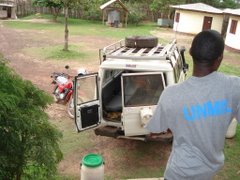
10) The already lush green trees and shrubbery delight in the attention they are given from the skies and they brighten up in an almost hallucinogenic way.
9) The amazingly hardworking women of Africa who spend every moment of their day doing something to help support their families (i.e., cooking, cleaning, gathering fire wood, pounding cassava, selling at the market) get to pause under an awning for at least one brief second, balancing the gender ratios under leafy mango trees or inside small gathering huts.
8) The visual of seeing a Bangladeshi UN peacekeeper walking down the road in full uniform holding an AK-47 in one hand and a pretty pink umbrella in the other.
7) The marvel of the sky as it shocks and awes everyone under its watch, constantly changing in form and color. One minute you see low flying clouds lining the tops of the palm trees and the next, rolling dark purple and blue clouds posturing for space in an ever changing atmosphere.
6) The thunder and lightening reminiscent of spring time thunder storms in the mid-west evoke fond memories from childhood. The crash and boom is fierce and unforgiving, but the pure natural intensity of the event forces one to think about the possibility of a higher power and all the worldly unknowns of our time.
5) The sight of umbrellas. From Ganta Parking in Gbargnga to Park Avenue in NYC I have always treasured the visual of umbrellas. They are like your own private delicate structure offering equal treatment to all and an escape from nature while remaining in it. A sea of color that looks like bouncing upside down tulips engaged in a grand ballet.
4) The significant drop in temperature offering a respite from the unrelenting heat.
3) The sound of rain falling on metal roof tops while lying in a hammock.
2) The pending occurrence of seeing plenty of goats standing on small things as they surface towards the sun to dry off. They stoically tilt their head towards the sky while balancing at an elevated altitude and appear to be telling the gods above: “You won’t get me that easily.”
1) The sheer amount of naked babies with distended bellies running through the rain with lathered soap shimmering on their skin. They know very well it is much easier to take advantage of this massive shower faucet from the skies than to wait and make a trip to the well to haul of gallons of dirty water back to their huts cross town. They glisten and shine in their unabashed activity and remind everyone about the innocence of childhood.
the risks involved with #6
It has recently come to my attention that there is some risk involved in loving thunder and lightening. Due to a number of confounding variables that lead to fatal accidents each year, lightening is an event that has the power to drastically change someone’s life, even if the individual isn’t directly touched by lightening.
Yesterday I visited the local jail – a long structure filled with half completed cells that is made to hold approximately 40 inmates. Currently it is holding more than 300. Although a drastic improvement from the pervious jail (a local hut with small piles of knee high bricks demarking the space between each cell allowing for somebody to escape with one high step that was controlled by guards with guns and other torture devises), the state of the new jail is a greivable human rights violation (please note I did make a report to the local UN human rights representative after my visit; we will see what happens with this complaint).
Sharon and I had been called to the jail because a local woman had been arrested for infanticide (murder of one’s newborn infant). Apparently 12 short hours after she delivered, she simply rose walked to the nearest public well and dropped her baby into the 24 foot abyss. The body was never found but there were some witnesses and she flatly admitted her act upon inquiry. Although this is unfortunately not a classic case of post-partum psychosis, mental health issues and prior trauma are evident and it is likely we can be of some assistance in her case and chance to receive some treatment.
In the cell next to this tragic nursing un-mother sat a thin man in his mid to late thirties. When we walked by his cell the guarded immediately began teasing him for the reason he was there. This man never looked up, not once, and he appeared almost catatonic. According to what was relayed during this heckling, he had been convicted of “death by lightening.”
Death my lightening is the charge someone gets when someone else in the community dies by lightening. You are at highest risk if you happen to be in an on-going dispute with the struck individual or had engaged in an argument with him or her in the days immediately proceeding the event. According to old juju beliefs someone who is vexed with somebody else, for reasons such as stealing a girlfriend or making a bad business deal, can go to a traditional witch doctor and participate in a cursing ceremony. From that day forward the object of their disaffection is at extreme risk of dying by accident. Lightening is just one of the many forms the curse can take.
The young man in the cell had been locked up since 2003 with no lawyer or trial granted. It was a given he was guilty because it was widely know he was “enemies” with the victim and this victim had died by lightening.
Morale of the story:
One must take the death by lightening phenomenon as a clear warning against joining the adorable naked babies playing in the rain but it shouldn’t stop you from appreciating the power of water, in all its many forms.
Monday, June 18, 2007


Thursday, June 14, 2007
possibilities
Alvin, the pockmark-faced amputee, rushes to direct me into a parking spot I am already half-way settled in and stops me as I exit my vehicle. “Good Day my friend,” he says, “I help you, now you help me.” Although unclear as to what “help” he had offered exactly, I nod curtly stating, “Yes I will get you on my way out, keep on eye on my car.” This is the deal, the destitute amputees “protect your vehicle” while your in the store and you tip them for it on the way out.
Alvin means well but something inside me bristles at his entitlement, and the aggressive way in which me makes me feel indebted to him. Just as quickly, I flush at the crudity of my own thoughts. I leave my new “friend” in charge of protecting the car and I enter the supermarket to buy some supplies for my pending trip up country.
As I exit the UN Supermarket, I am again accosted by a sea of beggars. They know their chances are much better on my way out as I may have some ‘small small’ change, making it nearly impossible to get past them without giving someone something. Three or four of them grab at my grocery bags and others simply make a path to my car. One quickly grabs at the door handle after I unlock it and asks for a handout. I manage to get in after tipping my friend Alvin and two other gentlemen for gesturing physical support while I placed my bags in the back seat. I take a deep sign and turn the ignition: nothing. Shit! Alpha Victor Two had overheated from a long day at work and I needed to do a hill start in 3rd gear to get the engine to turn over. In an effort to find humor in my predicament I pictured myself as one of the sub-characters from Little Miss Sunshine.
I open the window to 12 pair of gleaming eyes staring in at me knowing exactly how to help. One look at their faces tells me they are ready to push me get out of my predicament with only approximately 4 feet of open space to utilize for the roll. They quickly push me forward but the engine doesn’t turn, so they are forced to push me back to try again. In a perfect ironic twist thunder crashes and rain starts to fall. We try again – no deal. It becomes clear that I’m not completely savvy about these things and this gentleman peaks in my window and says, “Move over I’ll do it.” I look around and see all eyes on me and figure this guy won’t be able to do anything inappropriate with all these witnesses watching, so I scoot over and squat in the passenger seat. With rain falling hard, not one of my helpers moves toward the awning for cover.
Another car leaves, giving us approximately 2 more feet of room and my friend calls out a few fast commands in Liberian English and we are quickly being pushed at an exceptionally fast pace for such a limited area and then chug chug purrrrrrrrrrr – she’s good to go! My new buddy jumps out of the driver’s seat and walks away without looking back. The rest do the same (except for a few straggles hoping I might decide to tip them). Between the help, the rain and the lack of expectations I am nearly brought to tears by this expression of selfless charity and scream out, “Hey wait!” They all turn around quickly and move toward me. “Listen if I tip one of you will you break it up fairly amongst yourselves.” I get a quick “yes yes no problem” in surround sound. I check my wallet and hand one small boy a 20 dollar bill and speed off. I hear screeches of delight and see a few of them dancing in the rain in my rearview mirror. I wish I would have given more.
I shake my head, to clear out the earlier irritation I was feeling and I am overwhelmed with a warm feeling of optimism. With the rain falling hard, anything seemed possible.
Alvin means well but something inside me bristles at his entitlement, and the aggressive way in which me makes me feel indebted to him. Just as quickly, I flush at the crudity of my own thoughts. I leave my new “friend” in charge of protecting the car and I enter the supermarket to buy some supplies for my pending trip up country.
As I exit the UN Supermarket, I am again accosted by a sea of beggars. They know their chances are much better on my way out as I may have some ‘small small’ change, making it nearly impossible to get past them without giving someone something. Three or four of them grab at my grocery bags and others simply make a path to my car. One quickly grabs at the door handle after I unlock it and asks for a handout. I manage to get in after tipping my friend Alvin and two other gentlemen for gesturing physical support while I placed my bags in the back seat. I take a deep sign and turn the ignition: nothing. Shit! Alpha Victor Two had overheated from a long day at work and I needed to do a hill start in 3rd gear to get the engine to turn over. In an effort to find humor in my predicament I pictured myself as one of the sub-characters from Little Miss Sunshine.
I open the window to 12 pair of gleaming eyes staring in at me knowing exactly how to help. One look at their faces tells me they are ready to push me get out of my predicament with only approximately 4 feet of open space to utilize for the roll. They quickly push me forward but the engine doesn’t turn, so they are forced to push me back to try again. In a perfect ironic twist thunder crashes and rain starts to fall. We try again – no deal. It becomes clear that I’m not completely savvy about these things and this gentleman peaks in my window and says, “Move over I’ll do it.” I look around and see all eyes on me and figure this guy won’t be able to do anything inappropriate with all these witnesses watching, so I scoot over and squat in the passenger seat. With rain falling hard, not one of my helpers moves toward the awning for cover.
Another car leaves, giving us approximately 2 more feet of room and my friend calls out a few fast commands in Liberian English and we are quickly being pushed at an exceptionally fast pace for such a limited area and then chug chug purrrrrrrrrrr – she’s good to go! My new buddy jumps out of the driver’s seat and walks away without looking back. The rest do the same (except for a few straggles hoping I might decide to tip them). Between the help, the rain and the lack of expectations I am nearly brought to tears by this expression of selfless charity and scream out, “Hey wait!” They all turn around quickly and move toward me. “Listen if I tip one of you will you break it up fairly amongst yourselves.” I get a quick “yes yes no problem” in surround sound. I check my wallet and hand one small boy a 20 dollar bill and speed off. I hear screeches of delight and see a few of them dancing in the rain in my rearview mirror. I wish I would have given more.
I shake my head, to clear out the earlier irritation I was feeling and I am overwhelmed with a warm feeling of optimism. With the rain falling hard, anything seemed possible.
Monday, June 4, 2007
loss of innocence

Peace is much deeper than the absence of war.
Wars without beginnings, wars with pauses, but wars without ends.
War is an appetite.
It is its own reason for being.
There are no adequate answers.
The residue stings.
With war comes the loss of innocence for all involved.
For children, for women, for men, for soldiers, for leaders, for humanitarians.
No one is left untouched.
The loss of innocence becomes an appetite to experience the loss again. For others, being suddenly stripped, the collapse of the façade of ones virtue brings with it a peculiar feeling of debt, and the maddening cryptic question of who pays for someone else’s loss of innocence.
Or consider a loss of sexual innocence, whether by force or choice. Remembered as a loss, it can contribute to a life of grief, a life of anger or numbness. What comes of the choice to no longer be innocent is different for every pilgrim but to choose is to risk a region of the soul.
The Truth and Reconciliation Commission (TRC) in Liberia is coming along miserably, if at all. For a forensic psychologist, the concepts of truth, justice and accountability lie at the heart of my training and my understanding of victims, perpetrators and forgiveness. The process of recovery and rehabilitation includes victim impact statements and consequences, period. But, what if the system of justice is corrupt? Or what if the system alleges consequences but in reality it is a dangerous façade.
In Liberia the process is simple. What one sees is a group of men. These men carry clipboards (which sometimes causes them to be mistakenly perceived as Jehovah Witnesses). These men travel from house to house righteously demanding memories. With no opportunity for informed consent, support when the memories are too intense or a guarantee of anonymity, people wait in fear of the men with clipboards. With Prince Johnson (an infamous rebel leader who briefly broke away from Taylor in the late 90s only to create his very own rule of law that included heinous acts torture and power driven by fear) recently “elected” as the Senator of Nimba County, and rumors that President Ellen Sheriff financed and participated in the some of the destruction as a “revolutionary”, begs the question, why testify? Why remember when the leaders remain in power and indifference is pandemic.
In a few short months I have learned a few things. For me the goal is no longer to ensure that the names of those who sent others to die or serve or brainwash young children are prosecuted, but to reach a place where the victims recall their names only with difficulty when if ever they want to recall them. We cannot undo the past, but we can have a presence that will diminish its size, see to it that our experience of darkness does not take up more room than it’s due. The goal in recovery, I think is to circle back less and less.
This stance is against everything I believed in 6 months ago when I was sitting in the comfort of my library in the West studying war, truama and recovery. Is it ideal? – no. Is it satisfactory? – no. Does it bring more anger? – yes……but maybe embracing the anger, embracing it and them working through it is a first genuine step we can take towards healing.
We humanitarian workers will struggle most with this concept of anger as progress because it is we who believe war and aggression, anger and revenge fantasies should never be discussed or expressed; that only peace and forgiveness and kindness should prevail. But, if something heinous has occurred, something that is worthy of raw and unadulterated anger – isn’t the most genuine response to express it. Otherwise we are stuck - stuck in a limbo of sorts with feelings being repressed or denied, feelings that fester from generation to generation, feelings that if worked though have the possibility of leading us towards something new something outside the box we currently exist in.
It seems the wages of trauma is anger. The resolution of anger, my text books inform me, breaks the grip of the traumatic event. But how do we truly resolve the anger? It’s not enough just to arrive at a place where no one, not even yourself is to blame. You have to go further….
That is anger, now… on to love
How do we love if we are angry?
For me, I will start small
I will start with a mango
I will love a mango, its summer juice running down my chin
Then I will be in love with memories
The sound of my fathers car as it pulls up the driveway on a spring night, ready to enter
The look on my brohters face as he waits for his favorite pizza, lovingly picking up his dog and placing her on his shoulder, ready to love
The words of my favorite stories, given as a gift from friends who know how much I appreciate the retell, the familiar diction and delivery of a tale I have already heard but crave nonetheless, ready to soothe
The feelings connected to a recent relationship
The surge of energy that occured when our fingers accidentally brushed against one anothers
All that was then, all that is now, the slow semi-conscious physical gestures, everything I remember but won’t or can’t articulate because the words are unsupported by reason.
These feelings, these memories these sensory events – they make me feel innocent again.
Others may have a different journey towards the reemergence of innocence but this is my new theory – We must reengage our innocence to resolve the anger, to love.
Anger, innocence and love may sound simple or idealistic but when I am in these camps, or burnt out villages or mass grave sites it is not the events themselves or even the suffering that takes a fierce hold of me. The thing that has outraged me is the indifference I encounter all around it. I grew up thinking hate is the opposite of love, but now I believe it is indifference that is the true opposite of love.
At mass grave sites no one had even a piece of paper to write down the names of the dead.
At accident sites no one took even a moment to cover the young blameless bodies
At home, acts of domestic violence go unnoticed. Up and down every block the sound of the switch or the screaming of a woman hovered in a corner while nearby faces are flat with indifference – faces untouched by the violence.
Common sounds as tragic background music in an invalidated nation of angry victims.
Of course you could say that some man or woman, a group or government body, was to blame; but ordinarily selfishness or simple-mindedness is not the evil
It seems to be the shape of the indifference, the failure to love is what is toxic. This absence will take anyone down after a while, in any corner of the world.
Maybe indifference began by accommodating the impulse to affix blame. Growing out of a need to separate oneself from the brutality one witnessed. A need developed for expediency’s sake to make the suffering an abstraction.
To be angry or to be in love- both are loaded with consequence.
And I know that, at times, love can feel like the greatest of all risks
But not to follow it out, not to take the risk, wouldn’t that leave us isolated from all connections? To fall short of this final loss of innocence, to never say to another human being, I give you my life, wouldn’t that be the most tragic of all tragedies.
Wars without beginnings, wars with pauses, but wars without ends.
War is an appetite.
It is its own reason for being.
There are no adequate answers.
The residue stings.
With war comes the loss of innocence for all involved.
For children, for women, for men, for soldiers, for leaders, for humanitarians.
No one is left untouched.
The loss of innocence becomes an appetite to experience the loss again. For others, being suddenly stripped, the collapse of the façade of ones virtue brings with it a peculiar feeling of debt, and the maddening cryptic question of who pays for someone else’s loss of innocence.
Or consider a loss of sexual innocence, whether by force or choice. Remembered as a loss, it can contribute to a life of grief, a life of anger or numbness. What comes of the choice to no longer be innocent is different for every pilgrim but to choose is to risk a region of the soul.
The Truth and Reconciliation Commission (TRC) in Liberia is coming along miserably, if at all. For a forensic psychologist, the concepts of truth, justice and accountability lie at the heart of my training and my understanding of victims, perpetrators and forgiveness. The process of recovery and rehabilitation includes victim impact statements and consequences, period. But, what if the system of justice is corrupt? Or what if the system alleges consequences but in reality it is a dangerous façade.
In Liberia the process is simple. What one sees is a group of men. These men carry clipboards (which sometimes causes them to be mistakenly perceived as Jehovah Witnesses). These men travel from house to house righteously demanding memories. With no opportunity for informed consent, support when the memories are too intense or a guarantee of anonymity, people wait in fear of the men with clipboards. With Prince Johnson (an infamous rebel leader who briefly broke away from Taylor in the late 90s only to create his very own rule of law that included heinous acts torture and power driven by fear) recently “elected” as the Senator of Nimba County, and rumors that President Ellen Sheriff financed and participated in the some of the destruction as a “revolutionary”, begs the question, why testify? Why remember when the leaders remain in power and indifference is pandemic.
In a few short months I have learned a few things. For me the goal is no longer to ensure that the names of those who sent others to die or serve or brainwash young children are prosecuted, but to reach a place where the victims recall their names only with difficulty when if ever they want to recall them. We cannot undo the past, but we can have a presence that will diminish its size, see to it that our experience of darkness does not take up more room than it’s due. The goal in recovery, I think is to circle back less and less.
This stance is against everything I believed in 6 months ago when I was sitting in the comfort of my library in the West studying war, truama and recovery. Is it ideal? – no. Is it satisfactory? – no. Does it bring more anger? – yes……but maybe embracing the anger, embracing it and them working through it is a first genuine step we can take towards healing.
We humanitarian workers will struggle most with this concept of anger as progress because it is we who believe war and aggression, anger and revenge fantasies should never be discussed or expressed; that only peace and forgiveness and kindness should prevail. But, if something heinous has occurred, something that is worthy of raw and unadulterated anger – isn’t the most genuine response to express it. Otherwise we are stuck - stuck in a limbo of sorts with feelings being repressed or denied, feelings that fester from generation to generation, feelings that if worked though have the possibility of leading us towards something new something outside the box we currently exist in.
It seems the wages of trauma is anger. The resolution of anger, my text books inform me, breaks the grip of the traumatic event. But how do we truly resolve the anger? It’s not enough just to arrive at a place where no one, not even yourself is to blame. You have to go further….
That is anger, now… on to love
How do we love if we are angry?
For me, I will start small
I will start with a mango
I will love a mango, its summer juice running down my chin
Then I will be in love with memories
The sound of my fathers car as it pulls up the driveway on a spring night, ready to enter
The look on my brohters face as he waits for his favorite pizza, lovingly picking up his dog and placing her on his shoulder, ready to love
The words of my favorite stories, given as a gift from friends who know how much I appreciate the retell, the familiar diction and delivery of a tale I have already heard but crave nonetheless, ready to soothe
The feelings connected to a recent relationship
The surge of energy that occured when our fingers accidentally brushed against one anothers
All that was then, all that is now, the slow semi-conscious physical gestures, everything I remember but won’t or can’t articulate because the words are unsupported by reason.
These feelings, these memories these sensory events – they make me feel innocent again.
Others may have a different journey towards the reemergence of innocence but this is my new theory – We must reengage our innocence to resolve the anger, to love.
Anger, innocence and love may sound simple or idealistic but when I am in these camps, or burnt out villages or mass grave sites it is not the events themselves or even the suffering that takes a fierce hold of me. The thing that has outraged me is the indifference I encounter all around it. I grew up thinking hate is the opposite of love, but now I believe it is indifference that is the true opposite of love.
At mass grave sites no one had even a piece of paper to write down the names of the dead.
At accident sites no one took even a moment to cover the young blameless bodies
At home, acts of domestic violence go unnoticed. Up and down every block the sound of the switch or the screaming of a woman hovered in a corner while nearby faces are flat with indifference – faces untouched by the violence.
Common sounds as tragic background music in an invalidated nation of angry victims.
Of course you could say that some man or woman, a group or government body, was to blame; but ordinarily selfishness or simple-mindedness is not the evil
It seems to be the shape of the indifference, the failure to love is what is toxic. This absence will take anyone down after a while, in any corner of the world.
Maybe indifference began by accommodating the impulse to affix blame. Growing out of a need to separate oneself from the brutality one witnessed. A need developed for expediency’s sake to make the suffering an abstraction.
To be angry or to be in love- both are loaded with consequence.
And I know that, at times, love can feel like the greatest of all risks
But not to follow it out, not to take the risk, wouldn’t that leave us isolated from all connections? To fall short of this final loss of innocence, to never say to another human being, I give you my life, wouldn’t that be the most tragic of all tragedies.
Wednesday, May 30, 2007
where is my umbrella?

Flanked by paradox.
Monday I ended my day excited about a new endeavor - after hours Arabic lessons. Just last week, Sharon and I resolutely decided (over a glass of Pastis I might add) that fluency in Arabic would do wonders for us if we hope to have job security in the field of international disaster psychology. And, although like many Western women, I have negative associations with veiling – I (a recovering catholic) still miss the overt passion for religion, poetry and tradition that I encountered while living in a Muslim country.
Infected with a fatal case of wanderlust, learning a new language felt like an appropriate undertaking for two contemporary nomads. Sharon, a third generation single woman (with both a single mother and grandmother indicating a genetically transmitted flare for independence), and I, a transitional nester and relationshipphobe, felt like the main characters in the movie Chocolat. Two women, suitcases packed next to our bed, waiting for the wind to direct us to our next destination.
On the first day of our lessons, Musa arrived fifteen minutes early. Earnestly awaiting our call for him to enter the office, he sat under the shade of a mango tree. A young boy, sixteen years old at most, dressed in simple African Muslim attire, waiting patiently. With a gentle disposition and playful aura, Musa was accepted readily. He was referred to us by his father who was referred to us by our housekeeper’s abusive husband.
Once called upon Musa entered shyly with a simple piece of paper folded four times. The paper was filled with beautiful Arabic writing. “Good evening Musa” we say in unison. “Guud evening” we get in response and then quickly a sharp “Salaam a le ku. Wa a le ku salaam." That much we understand – the classic Arabic greeting and response. Musa has started and we were ready to follow.
Musa quickly moved on as we took ferocious notes. “we in al bu un su amiszeldt” he says. “we in al bu un su amiszeldt,” we repeat. Although our diction was poor, we were parroting him loudly and for one simple minute we were eager students dreaming of communicating in new lands. “A bu un su eesme.” “A bu un su eesme.” Wait wait wait!” We screech and ask him to stop. “Musa you are going too fast, What do all these things mean and can you please slow down so we can take notes?”
Musa looks up from the paper with a slightly perplexed look and says “now I continue?” And we say, “But, Musa we need to know what it all means and how to write it.” He replies, “Oh, ok, a bu un su amiszeldt means, where is my umbrella?” We giggle and look at each other, “Where is my umbrella?” Interesting starting point, but hey the rainy season is coming, lets be practical.
“Musa please help us. Can you do us a favor and write down how you would say these words phonetically, preferably in English, so we can practice.” “No, I can’t,” he replies blankly. “But what do you mean you can’t? “ He proceeds, talking quickly and in poorly articulated Liberian English that is being affected by a progressively more evident speech impediment, “I’m surry but I do not write in Enklish and I am just learning to speak ick, I cannot do the thinks that you ask.”
What a conundrum – our very sweet, very eager and very timely Arabic teacher could barley speak English and could not write English at all. It also became more and more evident that his increasing anxiety levels were activating his speech impediment, making it more and more difficult to pronounce the Arabic words he was trying to teach. Questions about grammar and syntax were simply out of the question. Dallas, I think we have a problem. But, did I mention how sweet Musa was?
Because we did not want to look rude or ungrateful we continued. However, we quickly realized that it was useless and no one, not even Musa, was benefiting from this facade. We tell poor Musa that it will not work and he tears up. He was going to get paid five US dollars an hour for this venture and it was clear he had already formulated an investment plan.
Sharon and I pack our bags, pay the poor boy and decide to go home to do some Pilates. Later that night we discuss alternative plans. Interestingly, French lessons by our three French neighbors who dog sit for Pappino when ever we are out of town was never tabled as an option.
The next morning I arrive at work fresh. Although I did not know what we were going to do about our language lessons I was excited to begin the day because I was starting two new trauma survivor support groups and felt a strong desire to engage in some clinical work rather than teach about it. Why? For one thing, psychotherapy consists of a gradual unfolding process wherein the therapist attempts to know the patient as fully as possible. Given my recent experience of not knowing anything including the languages, cultures, and interpersonal nuances of the people that surround me, getting to know a few real human beings by simply relating to them sounded refreshing.
But of course things are never that easy here in West Africa. I was scheduled to first attend a focal point training for the prevention of SEA (sexual exploitation and abuse) within international humanitarian organizations. I had already attended a two day training on this very topic earlier this month and my staff and subsequently selected me as the focal point for the organization. Given SEA is a serious problem in post-conflict/refugee environments where power means everything, I was passionate about the topic and honored to be selected. I was told this was a follow up training to the one I already attended.
Down one vehicle I was dropped off at the training site 45 minutes early which, here in Africa, means I was approximately an hour and 45 minutes early. Sitting patiently on a small bench in the shade, I watched two small men work on the engine of a UN Land Cruiser while a goat stubbornly played with the front wheel. The most interesting part of this visual was that the men were actually squatting on the front rim of the hood. They were able to do this because of their small statue (and flexibility I might add); the goat sounded like a small child chatting away, gnawing on the front tire.
At approximately 9:30 people started arriving and I entered the makeshift training hall. A small pad of paper and pen was handed to me along with a pre-test and an agenda for the three day training. I take one peak at the agenda and pre-test and I realize that this is the exact same training I attended three weeks prior. This was not a focal point training for selected focal points but rather a focal point training for organizations who had either missed the first training or who had not yet selected a focal point. After acing the pre-test (to help bolster our reputation or maybe to show off a little) I quickly called the office and told our administrator that he should send over the first PSC that arrived on scene to take my place. It was three days of interesting material and free lunch and I didn’t want my counselors to lose out. Approximately 10 minutes later Anita arrived on the back of a motorbike. The bike quickly took off and I am forced to chase him down the road screaming so that he would return me to the office. The office is about an hour walk away, something I would willingly do if it wasn’t for the hundred degree heat and lap top I was carrying in my satchel.
The driver and I safely arrive approximately 15 minutes later and I thanked him profusely. Given my recent run in with a fatal motorbike accident, even I, a former Harley aficionado, was a bit panicked to be on the back of a motorbike with a helmet that was so lose it spun around on my melon whenever we hit a bump.
Later I was informed that the driver was one of our security guards, Peabody. Interestingly Pea Body only has one functional eye and is unable to make eye contact with his other wondering eye. Why the office selected the only visually impaired individual on site to do all the transportation is beyond me, but I arrived safely and was forced to once again laugh at the irony of it all. A stuttering illiterate language teacher and a one eyed motorcycle driver, flanked by paradox, I look forward to what surprises lie ahead.
Monday I ended my day excited about a new endeavor - after hours Arabic lessons. Just last week, Sharon and I resolutely decided (over a glass of Pastis I might add) that fluency in Arabic would do wonders for us if we hope to have job security in the field of international disaster psychology. And, although like many Western women, I have negative associations with veiling – I (a recovering catholic) still miss the overt passion for religion, poetry and tradition that I encountered while living in a Muslim country.
Infected with a fatal case of wanderlust, learning a new language felt like an appropriate undertaking for two contemporary nomads. Sharon, a third generation single woman (with both a single mother and grandmother indicating a genetically transmitted flare for independence), and I, a transitional nester and relationshipphobe, felt like the main characters in the movie Chocolat. Two women, suitcases packed next to our bed, waiting for the wind to direct us to our next destination.
On the first day of our lessons, Musa arrived fifteen minutes early. Earnestly awaiting our call for him to enter the office, he sat under the shade of a mango tree. A young boy, sixteen years old at most, dressed in simple African Muslim attire, waiting patiently. With a gentle disposition and playful aura, Musa was accepted readily. He was referred to us by his father who was referred to us by our housekeeper’s abusive husband.
Once called upon Musa entered shyly with a simple piece of paper folded four times. The paper was filled with beautiful Arabic writing. “Good evening Musa” we say in unison. “Guud evening” we get in response and then quickly a sharp “Salaam a le ku. Wa a le ku salaam." That much we understand – the classic Arabic greeting and response. Musa has started and we were ready to follow.
Musa quickly moved on as we took ferocious notes. “we in al bu un su amiszeldt” he says. “we in al bu un su amiszeldt,” we repeat. Although our diction was poor, we were parroting him loudly and for one simple minute we were eager students dreaming of communicating in new lands. “A bu un su eesme.” “A bu un su eesme.” Wait wait wait!” We screech and ask him to stop. “Musa you are going too fast, What do all these things mean and can you please slow down so we can take notes?”
Musa looks up from the paper with a slightly perplexed look and says “now I continue?” And we say, “But, Musa we need to know what it all means and how to write it.” He replies, “Oh, ok, a bu un su amiszeldt means, where is my umbrella?” We giggle and look at each other, “Where is my umbrella?” Interesting starting point, but hey the rainy season is coming, lets be practical.
“Musa please help us. Can you do us a favor and write down how you would say these words phonetically, preferably in English, so we can practice.” “No, I can’t,” he replies blankly. “But what do you mean you can’t? “ He proceeds, talking quickly and in poorly articulated Liberian English that is being affected by a progressively more evident speech impediment, “I’m surry but I do not write in Enklish and I am just learning to speak ick, I cannot do the thinks that you ask.”
What a conundrum – our very sweet, very eager and very timely Arabic teacher could barley speak English and could not write English at all. It also became more and more evident that his increasing anxiety levels were activating his speech impediment, making it more and more difficult to pronounce the Arabic words he was trying to teach. Questions about grammar and syntax were simply out of the question. Dallas, I think we have a problem. But, did I mention how sweet Musa was?
Because we did not want to look rude or ungrateful we continued. However, we quickly realized that it was useless and no one, not even Musa, was benefiting from this facade. We tell poor Musa that it will not work and he tears up. He was going to get paid five US dollars an hour for this venture and it was clear he had already formulated an investment plan.
Sharon and I pack our bags, pay the poor boy and decide to go home to do some Pilates. Later that night we discuss alternative plans. Interestingly, French lessons by our three French neighbors who dog sit for Pappino when ever we are out of town was never tabled as an option.
The next morning I arrive at work fresh. Although I did not know what we were going to do about our language lessons I was excited to begin the day because I was starting two new trauma survivor support groups and felt a strong desire to engage in some clinical work rather than teach about it. Why? For one thing, psychotherapy consists of a gradual unfolding process wherein the therapist attempts to know the patient as fully as possible. Given my recent experience of not knowing anything including the languages, cultures, and interpersonal nuances of the people that surround me, getting to know a few real human beings by simply relating to them sounded refreshing.
But of course things are never that easy here in West Africa. I was scheduled to first attend a focal point training for the prevention of SEA (sexual exploitation and abuse) within international humanitarian organizations. I had already attended a two day training on this very topic earlier this month and my staff and subsequently selected me as the focal point for the organization. Given SEA is a serious problem in post-conflict/refugee environments where power means everything, I was passionate about the topic and honored to be selected. I was told this was a follow up training to the one I already attended.
Down one vehicle I was dropped off at the training site 45 minutes early which, here in Africa, means I was approximately an hour and 45 minutes early. Sitting patiently on a small bench in the shade, I watched two small men work on the engine of a UN Land Cruiser while a goat stubbornly played with the front wheel. The most interesting part of this visual was that the men were actually squatting on the front rim of the hood. They were able to do this because of their small statue (and flexibility I might add); the goat sounded like a small child chatting away, gnawing on the front tire.
At approximately 9:30 people started arriving and I entered the makeshift training hall. A small pad of paper and pen was handed to me along with a pre-test and an agenda for the three day training. I take one peak at the agenda and pre-test and I realize that this is the exact same training I attended three weeks prior. This was not a focal point training for selected focal points but rather a focal point training for organizations who had either missed the first training or who had not yet selected a focal point. After acing the pre-test (to help bolster our reputation or maybe to show off a little) I quickly called the office and told our administrator that he should send over the first PSC that arrived on scene to take my place. It was three days of interesting material and free lunch and I didn’t want my counselors to lose out. Approximately 10 minutes later Anita arrived on the back of a motorbike. The bike quickly took off and I am forced to chase him down the road screaming so that he would return me to the office. The office is about an hour walk away, something I would willingly do if it wasn’t for the hundred degree heat and lap top I was carrying in my satchel.
The driver and I safely arrive approximately 15 minutes later and I thanked him profusely. Given my recent run in with a fatal motorbike accident, even I, a former Harley aficionado, was a bit panicked to be on the back of a motorbike with a helmet that was so lose it spun around on my melon whenever we hit a bump.
Later I was informed that the driver was one of our security guards, Peabody. Interestingly Pea Body only has one functional eye and is unable to make eye contact with his other wondering eye. Why the office selected the only visually impaired individual on site to do all the transportation is beyond me, but I arrived safely and was forced to once again laugh at the irony of it all. A stuttering illiterate language teacher and a one eyed motorcycle driver, flanked by paradox, I look forward to what surprises lie ahead.
Monday, May 28, 2007
a bend in the path
is post is about a bend in a heart and a bend in a path. The events following my encounter with a bent heart were astonishing; the events following my journey around the slight curve were tormenting.
the bent heart
17 hours ago I started out my morning, slightly tired. It was day 11 of clinical and administrative meetings with a number of individuals from headquarters. Three fellow clinicians and myself, our county director, five members from our sister site in DRC, two members from our sister site in Sierra Leon and six members from HQ just completed a 6 day clinical retreat at Thinkers Village, a local beachside hotel. It was six days of meetings, de-briefings, break-out groups, and problem solving. Back at our district sites we were playing host as well as subordinate; while serving fu fu and mango shakes we were being evaluated and quizzed about our work. Thankfully the evaluation was not on the diversity of our cuisine because rice and mangos are about the only option we currently have – as our cook humbly says every morning – “the market is dry.” To add to the blurring of boundaries that occur when you are feeding your boss, our supervisors were staying with us in our home and we had to plan outings and social activities so they could go home with eclectic memories of West Africa. By day 10 everyone had left for their respective homes aside from our clinical supervisor - so Sharon and I prepped for our last big last hurdle.
We planned to get our supervisor out to visit our project activities and remote field sites. On site we showed her our programming, groups, community activities. On this final morning it was my turn to showcase our activities. The plan was as follows: I would take her to our three district sites (45 and 55 and 125 minutes away respectively). We would attend groups and then continue on to Dukku to attend a GBV (Gender Based Violence) Task Force Meeting. After that we would facilitate a case conference with our counselors working in Mossorado County.
After waiting 25 minutes for our admin assistant, Sam Ponnie, (an uninformed addition to our caravan who needed to run home and pack for an overnight training with the database representative from HQ), we managed to depart for the first site with only a 30 minute delay. We arrived in Belefanai 25 minutes late for the start of a women’s group. Fortunately the women were just starting to gather. We joined the woman in a small empty room in a house that was half built with no roof. We placed straw mats on the floor and took off our shoes at the makeshift entrance. As we sat on the floor we smiled at the few women who were present; the peer support counselors busied themselves with preparations and calling for the other group members. Five minutes later I was in a small room filled with 16 women (6 more than had originally singed up for the group but women who reported serious trauma nonetheless). Seven of the women were nursing babies. One question presented itself, do we start as is or do we turn the uninvited ones away? The new additions expressed a genuine desire to attend and understood the parameters of the group, so we acquiesced. With one quick glance at their desperate faces we kept them all in the packed room and planned to break the group up into two the following week.
Sitting side by side with nursing mothers and the local counselors I felt honored to be involved but also knew my skin color was striking. We went around the room and did brief introductions and talked about “a good memory.” They women (all strangers to me) called me Gomah, referencing the Kpelle name I had been gifted a few weeks prior by the village community leader I had spoke with get to permission to work in the village. Apparently Gwen is not a familiar name in Liberia and due to the fact it was difficult for him to wrap his month around it, he stared at me for a second placed his hand on his chin and simple stated – I will call you Gomah. These women had apparently been informed. It was clearly a complement and I accepted the gift willingly. With this new information I proceeded to say, “Ya un, cu man y? na ba Gomah.” (Good morning, how are you coming along? My name is Gomah.)
The fond memory activity was easy for some but remarkably difficult for others. Life is hard in Liberia and good memories can be difficult to access for those who have shut themselves off from the past. Even the possibility of feeling vulnerable feels like a weakness and access point for exploitation. But, one woman proudly raised her hand and wanted to be the first to share. I took one look at her and wondered why she had even joined this group. She had a glow to her and a sparkle in her eye and she seemed about as out of place as me. Her story quickly dismantled my confusion.
** Hawatu was a widow and the mother of 2 children; a girl, age 5 and a boy, age 7. Three months ago she had sent her children to Monrovia to live with their auntie so they could attend a better school. It was hard for her to let them go but she believed she was making the best choice for their future. Horrifyingly, a few days after the children arrived, they went missing. There were rumors that the children had been kidnapped by a cult group practicing black magic that needed human organs for ju-ju sacrifices. Young children are typically the first to go missing for such practices and they are vulnerable and common targets in the markets.
Given I told you we were talking about “good memories” I’m sure you can image what I am about to say next and you would be correct and the story of their return is moving. Hawatu’s little ones were so sad and so desperate to be back with their mother that after arriving in Monrovia they decided to walk home, a 350 mile journey. They each packed a little sack with mangos and grumpy nuts and walked right out of big bad Monrovia for what ended up being a three month journey.
These two small but determined children had been frequently stopped along the way. Each time there were stopped they were fortunate enough to run into a Good Samaritan who took them into their own home to care for them. On more than one occasion Hawatu’s children were mistakenly assumed to be confused “orphans” living in a fantasy that their mother was still alive but in reality they were in desperate need of caretakers. After a few days or even weeks with these kind strangers, Howatu’s little ones would pack up their sacks and once again and start walking home. They arrived the evening before our group session. Hawatu was beside herself with joy, relief and pride.
the bent path
The story of the bend in the path is much less touching, but it was part of my day nonetheless and it captured the elusive nature of safety and happiness here in Liberia. Following the close of the group, we packed up the Land Cruiser and headed due west on a dirt road. After a few miles, we hit a rare patch of pavement. Even though it is a reprise on one’s back to be off the dirt roads, you quickly are struck by the speed in which all the vehicles start to move. We turned a corner and then another and then we noticed a gathering up a head and were forced to slow down. Upon approach we realized there had been an accident and before I had time to prepare I saw two small children, one girl and one boy (ages 9 and 14 respectively) broken, bloody and deceased on the pavement. It was horrifying and called for a moment of silence but this moment was not granted because in the second it took to look up, we realized something very scary was happening. The truck that had hit these children had turned off the road and was driving through the bush. Young men and teenage boys in the area quickly gathered and began chasing the run away vehicle. People were screaming and police sirens were coming but it was evident their arrival would be too late. The children were gone and it was clear some locals had decided the fate of the driver. There was nothing we could do so we simply pulled off the side of the road and continued. Linda and I started to cry, our driver began to fidget nervously and blasted the world news filled with the horrors of the Middle East and other parts of Africa, and Sam Ponnie turned up the volume on the I-Pod I had lent him and quietly started singing.
Accidents happen everywhere but the violent response of the community shook me to my core and put me in an existential funk for the remainder of the trip. Can a nation with such a reflexive violent reaction to tragic events be reprogrammed? At what point have things simply gone too far? My mind racing, fatigue taking hold, I gazed out the window and was ironically struck with an image of police barracks - unlivable to most, filled with poorly paid men with dirty uniforms they wore on and off the clock with entrenched expectations of bribes, arrests being something the accuser pays for, convictions being rare and fleeting.
I turned to Sam Ponnie and asked if he ever felt disheartened, given the situation we just experienced, if he felt his work, and the work of other honest hark working patriots like himself, amounted to something. He didn’t glace over at my question. He remained focused on his hands, inspecting his nails. “No,” he answered, “I believe change is a constant and the fighting has stopped. Rome wasn’t built in a day.” This stock phrase would have been empty, elsewhere. But here the words carried strange weight, for it was possible to feel, in Liberia, what it would take to transform a society, to build a new civilization. The immensity of the task was palpable. Looking around it appeared that there is a relentless burden on the shoulders of men like Sam Ponny, a constant resistance to every step, for anyone who aimed at even a part of such change. My shoulders felt too weak, my lungs too shallow, to contemplate it.
** names in all my tales are changed for their protection and confidentiality.
the bent heart
17 hours ago I started out my morning, slightly tired. It was day 11 of clinical and administrative meetings with a number of individuals from headquarters. Three fellow clinicians and myself, our county director, five members from our sister site in DRC, two members from our sister site in Sierra Leon and six members from HQ just completed a 6 day clinical retreat at Thinkers Village, a local beachside hotel. It was six days of meetings, de-briefings, break-out groups, and problem solving. Back at our district sites we were playing host as well as subordinate; while serving fu fu and mango shakes we were being evaluated and quizzed about our work. Thankfully the evaluation was not on the diversity of our cuisine because rice and mangos are about the only option we currently have – as our cook humbly says every morning – “the market is dry.” To add to the blurring of boundaries that occur when you are feeding your boss, our supervisors were staying with us in our home and we had to plan outings and social activities so they could go home with eclectic memories of West Africa. By day 10 everyone had left for their respective homes aside from our clinical supervisor - so Sharon and I prepped for our last big last hurdle.
We planned to get our supervisor out to visit our project activities and remote field sites. On site we showed her our programming, groups, community activities. On this final morning it was my turn to showcase our activities. The plan was as follows: I would take her to our three district sites (45 and 55 and 125 minutes away respectively). We would attend groups and then continue on to Dukku to attend a GBV (Gender Based Violence) Task Force Meeting. After that we would facilitate a case conference with our counselors working in Mossorado County.
After waiting 25 minutes for our admin assistant, Sam Ponnie, (an uninformed addition to our caravan who needed to run home and pack for an overnight training with the database representative from HQ), we managed to depart for the first site with only a 30 minute delay. We arrived in Belefanai 25 minutes late for the start of a women’s group. Fortunately the women were just starting to gather. We joined the woman in a small empty room in a house that was half built with no roof. We placed straw mats on the floor and took off our shoes at the makeshift entrance. As we sat on the floor we smiled at the few women who were present; the peer support counselors busied themselves with preparations and calling for the other group members. Five minutes later I was in a small room filled with 16 women (6 more than had originally singed up for the group but women who reported serious trauma nonetheless). Seven of the women were nursing babies. One question presented itself, do we start as is or do we turn the uninvited ones away? The new additions expressed a genuine desire to attend and understood the parameters of the group, so we acquiesced. With one quick glance at their desperate faces we kept them all in the packed room and planned to break the group up into two the following week.
Sitting side by side with nursing mothers and the local counselors I felt honored to be involved but also knew my skin color was striking. We went around the room and did brief introductions and talked about “a good memory.” They women (all strangers to me) called me Gomah, referencing the Kpelle name I had been gifted a few weeks prior by the village community leader I had spoke with get to permission to work in the village. Apparently Gwen is not a familiar name in Liberia and due to the fact it was difficult for him to wrap his month around it, he stared at me for a second placed his hand on his chin and simple stated – I will call you Gomah. These women had apparently been informed. It was clearly a complement and I accepted the gift willingly. With this new information I proceeded to say, “Ya un, cu man y? na ba Gomah.” (Good morning, how are you coming along? My name is Gomah.)
The fond memory activity was easy for some but remarkably difficult for others. Life is hard in Liberia and good memories can be difficult to access for those who have shut themselves off from the past. Even the possibility of feeling vulnerable feels like a weakness and access point for exploitation. But, one woman proudly raised her hand and wanted to be the first to share. I took one look at her and wondered why she had even joined this group. She had a glow to her and a sparkle in her eye and she seemed about as out of place as me. Her story quickly dismantled my confusion.
** Hawatu was a widow and the mother of 2 children; a girl, age 5 and a boy, age 7. Three months ago she had sent her children to Monrovia to live with their auntie so they could attend a better school. It was hard for her to let them go but she believed she was making the best choice for their future. Horrifyingly, a few days after the children arrived, they went missing. There were rumors that the children had been kidnapped by a cult group practicing black magic that needed human organs for ju-ju sacrifices. Young children are typically the first to go missing for such practices and they are vulnerable and common targets in the markets.
Given I told you we were talking about “good memories” I’m sure you can image what I am about to say next and you would be correct and the story of their return is moving. Hawatu’s little ones were so sad and so desperate to be back with their mother that after arriving in Monrovia they decided to walk home, a 350 mile journey. They each packed a little sack with mangos and grumpy nuts and walked right out of big bad Monrovia for what ended up being a three month journey.
These two small but determined children had been frequently stopped along the way. Each time there were stopped they were fortunate enough to run into a Good Samaritan who took them into their own home to care for them. On more than one occasion Hawatu’s children were mistakenly assumed to be confused “orphans” living in a fantasy that their mother was still alive but in reality they were in desperate need of caretakers. After a few days or even weeks with these kind strangers, Howatu’s little ones would pack up their sacks and once again and start walking home. They arrived the evening before our group session. Hawatu was beside herself with joy, relief and pride.
the bent path
The story of the bend in the path is much less touching, but it was part of my day nonetheless and it captured the elusive nature of safety and happiness here in Liberia. Following the close of the group, we packed up the Land Cruiser and headed due west on a dirt road. After a few miles, we hit a rare patch of pavement. Even though it is a reprise on one’s back to be off the dirt roads, you quickly are struck by the speed in which all the vehicles start to move. We turned a corner and then another and then we noticed a gathering up a head and were forced to slow down. Upon approach we realized there had been an accident and before I had time to prepare I saw two small children, one girl and one boy (ages 9 and 14 respectively) broken, bloody and deceased on the pavement. It was horrifying and called for a moment of silence but this moment was not granted because in the second it took to look up, we realized something very scary was happening. The truck that had hit these children had turned off the road and was driving through the bush. Young men and teenage boys in the area quickly gathered and began chasing the run away vehicle. People were screaming and police sirens were coming but it was evident their arrival would be too late. The children were gone and it was clear some locals had decided the fate of the driver. There was nothing we could do so we simply pulled off the side of the road and continued. Linda and I started to cry, our driver began to fidget nervously and blasted the world news filled with the horrors of the Middle East and other parts of Africa, and Sam Ponnie turned up the volume on the I-Pod I had lent him and quietly started singing.
Accidents happen everywhere but the violent response of the community shook me to my core and put me in an existential funk for the remainder of the trip. Can a nation with such a reflexive violent reaction to tragic events be reprogrammed? At what point have things simply gone too far? My mind racing, fatigue taking hold, I gazed out the window and was ironically struck with an image of police barracks - unlivable to most, filled with poorly paid men with dirty uniforms they wore on and off the clock with entrenched expectations of bribes, arrests being something the accuser pays for, convictions being rare and fleeting.
I turned to Sam Ponnie and asked if he ever felt disheartened, given the situation we just experienced, if he felt his work, and the work of other honest hark working patriots like himself, amounted to something. He didn’t glace over at my question. He remained focused on his hands, inspecting his nails. “No,” he answered, “I believe change is a constant and the fighting has stopped. Rome wasn’t built in a day.” This stock phrase would have been empty, elsewhere. But here the words carried strange weight, for it was possible to feel, in Liberia, what it would take to transform a society, to build a new civilization. The immensity of the task was palpable. Looking around it appeared that there is a relentless burden on the shoulders of men like Sam Ponny, a constant resistance to every step, for anyone who aimed at even a part of such change. My shoulders felt too weak, my lungs too shallow, to contemplate it.
** names in all my tales are changed for their protection and confidentiality.
Wednesday, May 9, 2007
Sasha's Recidivism
Sasha killed a gecko yesterday. This specific act of recidivism indicates she failed her DDR program. DDR stands for disarmament, demobilization, and reintegration. DDR of ex-combatants is frequently a first step in the transition from war to peace. Demilitarization can be used in times of peace as well, to reduce the size of armed forces and redistribute public spending. However, DDR is much more complicated in a post-conflict environment, when different fighting groups are divided by animosities and face a real security dilemma as they give up their weapons, when civil society structures have crumbled, and when the economy is stagnant.
Children who have grown up within an armed group have been exposed to ongoing atrocities. This chronic exposure at a very young age makes it very difficult to reintegrate into society, partly because they simply know nothing else, and partly because all of this occurred during critical developmentally formative years. DDR is the catch phrase used to describe the programming or should I say re-programming of ex-child combatants. Child soldiers are a hot topic internationally given recent highlights of them in movies like Blood Diamonds and books like The Long Way Home (which both highlight Sierra Leon, Liberia’s neighbor) and here in Liberia the conscription of child soldiers was commonplace for nearly a decade.
Gbargnga and Lofa, the two district towns I live and work in are full of ex-combatants and consequently DDR programs. It is an eerie feeling to be walking in a market or traveling down a road or even playing a little basketball with some local teens and being struck with the realization that these adorable adolescents were all ex-combatants. At times, when the air is blowing in a certain direction (even in this hundred plus degree weather) the feeling is downright chilling. The heaviness in the air is at times tied to overt tensions, other times it is more covert apprehensions, but there is no doubt a residue remains. It’s as if past emotional states are on the verge of re-surfacing and the only thing that would need to occur is an ignition of a very combustible and very short ex-combatant communal fuse. For example, there was an incident a few weeks ago where a group of boys were upset about the way the local police interviewed a possible suspect. In approximately 41 minutes nearly 700 ex-combatants were organized with weapons at a local police sub-station chanting their message. Grassroots political activists in the west will likely read this with a hint of organizational envy.
But let me return to dear Sasha. Sasha is a cat. She was adopted by my Kenyan teammate Michael after we had some problems with rats in the ex-pat house. At first the rats were a nuance but then, after an outbreak of Lassa fever – the issues of rats quickly became an issue of security. Lassa fever (like Yellow Fever) is a viral hemorrhagic fever endemic in West and Central Africa. The Lassa virus is transmitted from rats to humans by either direct contact or by mucosal exposure. Among causative agents Lassa affects the second largest number of people (after dengue). Based on epidemiological studies in Sierra Leone, Liberia, Guinea and Nigeria, the ‘‘at risk’’ sero-negative population in these countries may be as high as 59 million, with an annual incidence of illness of 3 million, fatalities up to 67 thousand and up to 3 million re-infections. My aim with these statistics is to make you a little bit nervous about my well-being because they downright terrified me and my teammates, hence the cat.
Michael rightfully believed that most animals were best used for dining purposes; therefore, he didn’t get too excited about having a pet, let alone a cat. But, he changed his tune when Lassa fever became a real threat. An added bonus was that our new housemate delivered. Sasha was an excellent hunter and managed to literally “clean house” in 2 short weeks. Not a single rat and better yet, not a single rat dropping, was to be found. Michael didn’t bother feeding Sasha because she was evidently managing on her own.
A few weeks after we squelched the lassa fever issue Michael’s new teammate, Kscared, arrived. Kscared is an American girl from DC who left behind one important thing - her pride and joy, her only child - Paris (a small “Pugier” which is labradoodle speak for part Pug part Boston terrier). Some of you may not believe this but I think Kscared may even be a little more extreme than me with regards to her affection for her pet. I may tear up a bit when I speak of my two Tuesdays or try to interject some sort of Tuesday tale into any given conversations, but Kscared managed to take her affection to a new level and referred to Paris as her “baby” and was eminently prepared to show pictures of Paris from both her lap top as well as her wallet, whenever she was given the chance. Local staff continues to get a kick out of this and take every opportunity to inquire about Paris’s well being, simply so they can see Kscared’s reaction.
Upon arriving in Lofa, Kscared was happy to take Sasha in, but due to the fact the Lassa fever scare was over, Sasha’s homicidal tendencies needed to be curbed. By this point there were rumors that Sasha was attacking small children in the neighborhood and the cook was complaining because Sasha had literally declared war on a chicken that was brought into the compound for an ex-pat dinner. Sasha needed to become sweet and well behaved if she was going to be allowed to stick around.
So, DDR began in the CVT-Lofa compound. First, Sasha was to learn that she was not suppose to hunt, kill or mar any living thing in the house; Michael, Kscared and all the friendly mosquito eating geckos and chickens included. She was also given a flee bath and allowed to sit on the couch -if she refrained from scratching everyone (disarmament). Next, she was to learn she would get fed cat food by Kscared at a very specific time and in a very specific place (demobilization). And, finally she was to be assimilated back into the family system vis-à-vis frequent pettings and sweet conversations in cat-speak (i.e., that voice we humans put on when speaking to household pets) (reintegration).
At first Sasha’s DDR program was quite successful. Sasha had a full belly and was getting used to all the attention. By the end of the third week Sasha was even getting demanding – meowing at every passerbyer and doing laps around any able-bodied pair of legs that entered the house with requests for tactile attention. But then tragedy struck. Poor Sasha got bored and on a warm and cloudless day in April (that we now refer to April Twenty), Sasha went on a homicidal killing spree. Sasha had spent an entire day hunting and upon our return, she had 5 gecko corpses lined up on the porch and two additional amputees were spotted on the wall in the bathroom.
Sasha cracked. But, just as quickly as she regressed into her earlier professional hit-man identity, she recovered and was meowing and looking for a scratch behind her ear asserting blissful ignorance of her digression.
Sasha’s problem is not unique. The DDR programs in Liberia, although well meaning and aptly developed, have a few fatal flaws. First, it is tragic for the survivors. Women, children and boys who managed to avoid getting conscripted into Taylor’s armies or were themselves victims of brutal aggressions executed by these young rebel groups were once again ignored and reminded that sometimes crime does, in fact, pay. The DDR participants were given jobs and social cards that allowed them regular access to food programs as well as monthly allowances. The aim was to keep them busy and satisfied so they wouldn’t act out – but what of the victims? Not to mention sustainability. Second, the social cards and free resources were clearly facilitating a process of leaned helplessness and the ex-combatants quickly learned that if they simply threatened to act up they were immediately given what they asked for and were frequently offered more services. Just as was the case with Sasha, these boys were getting bored and the bar was continually being raised. Everything was being handed to them (or at least they were receiving more than their civilian neighbors) – and given the rates of school violence in the west, we all know what bored antisocial punks can manage to do if provoked or armed.
Children who have grown up within an armed group have been exposed to ongoing atrocities. This chronic exposure at a very young age makes it very difficult to reintegrate into society, partly because they simply know nothing else, and partly because all of this occurred during critical developmentally formative years. DDR is the catch phrase used to describe the programming or should I say re-programming of ex-child combatants. Child soldiers are a hot topic internationally given recent highlights of them in movies like Blood Diamonds and books like The Long Way Home (which both highlight Sierra Leon, Liberia’s neighbor) and here in Liberia the conscription of child soldiers was commonplace for nearly a decade.
Gbargnga and Lofa, the two district towns I live and work in are full of ex-combatants and consequently DDR programs. It is an eerie feeling to be walking in a market or traveling down a road or even playing a little basketball with some local teens and being struck with the realization that these adorable adolescents were all ex-combatants. At times, when the air is blowing in a certain direction (even in this hundred plus degree weather) the feeling is downright chilling. The heaviness in the air is at times tied to overt tensions, other times it is more covert apprehensions, but there is no doubt a residue remains. It’s as if past emotional states are on the verge of re-surfacing and the only thing that would need to occur is an ignition of a very combustible and very short ex-combatant communal fuse. For example, there was an incident a few weeks ago where a group of boys were upset about the way the local police interviewed a possible suspect. In approximately 41 minutes nearly 700 ex-combatants were organized with weapons at a local police sub-station chanting their message. Grassroots political activists in the west will likely read this with a hint of organizational envy.
But let me return to dear Sasha. Sasha is a cat. She was adopted by my Kenyan teammate Michael after we had some problems with rats in the ex-pat house. At first the rats were a nuance but then, after an outbreak of Lassa fever – the issues of rats quickly became an issue of security. Lassa fever (like Yellow Fever) is a viral hemorrhagic fever endemic in West and Central Africa. The Lassa virus is transmitted from rats to humans by either direct contact or by mucosal exposure. Among causative agents Lassa affects the second largest number of people (after dengue). Based on epidemiological studies in Sierra Leone, Liberia, Guinea and Nigeria, the ‘‘at risk’’ sero-negative population in these countries may be as high as 59 million, with an annual incidence of illness of 3 million, fatalities up to 67 thousand and up to 3 million re-infections. My aim with these statistics is to make you a little bit nervous about my well-being because they downright terrified me and my teammates, hence the cat.
Michael rightfully believed that most animals were best used for dining purposes; therefore, he didn’t get too excited about having a pet, let alone a cat. But, he changed his tune when Lassa fever became a real threat. An added bonus was that our new housemate delivered. Sasha was an excellent hunter and managed to literally “clean house” in 2 short weeks. Not a single rat and better yet, not a single rat dropping, was to be found. Michael didn’t bother feeding Sasha because she was evidently managing on her own.
A few weeks after we squelched the lassa fever issue Michael’s new teammate, Kscared, arrived. Kscared is an American girl from DC who left behind one important thing - her pride and joy, her only child - Paris (a small “Pugier” which is labradoodle speak for part Pug part Boston terrier). Some of you may not believe this but I think Kscared may even be a little more extreme than me with regards to her affection for her pet. I may tear up a bit when I speak of my two Tuesdays or try to interject some sort of Tuesday tale into any given conversations, but Kscared managed to take her affection to a new level and referred to Paris as her “baby” and was eminently prepared to show pictures of Paris from both her lap top as well as her wallet, whenever she was given the chance. Local staff continues to get a kick out of this and take every opportunity to inquire about Paris’s well being, simply so they can see Kscared’s reaction.
Upon arriving in Lofa, Kscared was happy to take Sasha in, but due to the fact the Lassa fever scare was over, Sasha’s homicidal tendencies needed to be curbed. By this point there were rumors that Sasha was attacking small children in the neighborhood and the cook was complaining because Sasha had literally declared war on a chicken that was brought into the compound for an ex-pat dinner. Sasha needed to become sweet and well behaved if she was going to be allowed to stick around.
So, DDR began in the CVT-Lofa compound. First, Sasha was to learn that she was not suppose to hunt, kill or mar any living thing in the house; Michael, Kscared and all the friendly mosquito eating geckos and chickens included. She was also given a flee bath and allowed to sit on the couch -if she refrained from scratching everyone (disarmament). Next, she was to learn she would get fed cat food by Kscared at a very specific time and in a very specific place (demobilization). And, finally she was to be assimilated back into the family system vis-à-vis frequent pettings and sweet conversations in cat-speak (i.e., that voice we humans put on when speaking to household pets) (reintegration).
At first Sasha’s DDR program was quite successful. Sasha had a full belly and was getting used to all the attention. By the end of the third week Sasha was even getting demanding – meowing at every passerbyer and doing laps around any able-bodied pair of legs that entered the house with requests for tactile attention. But then tragedy struck. Poor Sasha got bored and on a warm and cloudless day in April (that we now refer to April Twenty), Sasha went on a homicidal killing spree. Sasha had spent an entire day hunting and upon our return, she had 5 gecko corpses lined up on the porch and two additional amputees were spotted on the wall in the bathroom.
Sasha cracked. But, just as quickly as she regressed into her earlier professional hit-man identity, she recovered and was meowing and looking for a scratch behind her ear asserting blissful ignorance of her digression.
Sasha’s problem is not unique. The DDR programs in Liberia, although well meaning and aptly developed, have a few fatal flaws. First, it is tragic for the survivors. Women, children and boys who managed to avoid getting conscripted into Taylor’s armies or were themselves victims of brutal aggressions executed by these young rebel groups were once again ignored and reminded that sometimes crime does, in fact, pay. The DDR participants were given jobs and social cards that allowed them regular access to food programs as well as monthly allowances. The aim was to keep them busy and satisfied so they wouldn’t act out – but what of the victims? Not to mention sustainability. Second, the social cards and free resources were clearly facilitating a process of leaned helplessness and the ex-combatants quickly learned that if they simply threatened to act up they were immediately given what they asked for and were frequently offered more services. Just as was the case with Sasha, these boys were getting bored and the bar was continually being raised. Everything was being handed to them (or at least they were receiving more than their civilian neighbors) – and given the rates of school violence in the west, we all know what bored antisocial punks can manage to do if provoked or armed.
Tuesday, May 8, 2007
aptitude & curse
So it seems that the ability to relive past emotional states is both an aptitude and a curse. It’s a curse because sometimes it doesn’t allow you to get on with your life. Every wound, every bruise, every assault, yields a harvest which is then stored. The pain is kept on ice and can be relied upon to taste as fresh as the day it was inflicted.
A few of my local counselors here in Liberia seem to be both cursed and blessed in abundance. Their ability to feel profoundly and relive the past makes them excellent counselors, but every day they do this work I worry. The stories they hear affect them deeply, especially because they share in the collective trauma everyone here is suffering. Some days it appears that the simple act of bearing witness to the stories they hear transcends them; but, on other days the stories they hear are glaringly reminders of their own traumas, and these reminders are relentless and unforgiving.
I feel like I owe them a warning. About what, I am less clear, but I desperately want to protect these 26 brave souls who decided to dedicate their lives to help fellow trauma survivors. I want to warn them about what this work can sometimes do to people and I want to share with them a few simple truths about man’s proclivity to behave inhumanly. I somehow want to lessen the burden they feel, but what would I say? Between telling them the truth and remaining brutally silent, I fear the less hurtful option is silence.
Really, what can one say to explain away their experienced atrocities? It's painful to hear their stories but it would more painful if they didn’t tell me, if they didn’t trust me or believe I wanted to hear them. It’s painful to feel the suffering when one knows some of what has happened, what is happening, could have been stopped. If there were resources or adequate interventions, women could be protected, a nonsense war would not have lasted 14 years, parents would not be burying their children, malignant leaders would be held accountable for their propaganda and lies, and mothers would not have to discover their 13 year old daughter is pregnant as a result of rape at the hands of a school teacher who threatened to fail her if she did not surrender. How can this be, in a world of endless wealth and resources? Why doesn't somebody just put their foot down or open their jaw like a whale and swallow the brazenness in one gulp?
With all that being said, I have to report I am again left feeling somewhat hopeful. I think of these aforementioned glimpse of utter compassion and I am left with a sense of humanity and belonging to my work here and for that, I am grateful. It feels like a conversation with something larger than myself, a felt participation, and a touch of spiritual fulfillment and the mysterious generative nature of that fulfillment. Whether this fulfillment lasts for a few more minutes or a few months, I am not complaining of its appearance. So now I must choose and I have decided to set out boldly in my work, and remember that the outcome of this endeavor is not what I manage to accomplish but who I become while accomplishing it.
A few of my local counselors here in Liberia seem to be both cursed and blessed in abundance. Their ability to feel profoundly and relive the past makes them excellent counselors, but every day they do this work I worry. The stories they hear affect them deeply, especially because they share in the collective trauma everyone here is suffering. Some days it appears that the simple act of bearing witness to the stories they hear transcends them; but, on other days the stories they hear are glaringly reminders of their own traumas, and these reminders are relentless and unforgiving.
I feel like I owe them a warning. About what, I am less clear, but I desperately want to protect these 26 brave souls who decided to dedicate their lives to help fellow trauma survivors. I want to warn them about what this work can sometimes do to people and I want to share with them a few simple truths about man’s proclivity to behave inhumanly. I somehow want to lessen the burden they feel, but what would I say? Between telling them the truth and remaining brutally silent, I fear the less hurtful option is silence.
Really, what can one say to explain away their experienced atrocities? It's painful to hear their stories but it would more painful if they didn’t tell me, if they didn’t trust me or believe I wanted to hear them. It’s painful to feel the suffering when one knows some of what has happened, what is happening, could have been stopped. If there were resources or adequate interventions, women could be protected, a nonsense war would not have lasted 14 years, parents would not be burying their children, malignant leaders would be held accountable for their propaganda and lies, and mothers would not have to discover their 13 year old daughter is pregnant as a result of rape at the hands of a school teacher who threatened to fail her if she did not surrender. How can this be, in a world of endless wealth and resources? Why doesn't somebody just put their foot down or open their jaw like a whale and swallow the brazenness in one gulp?
With all that being said, I have to report I am again left feeling somewhat hopeful. I think of these aforementioned glimpse of utter compassion and I am left with a sense of humanity and belonging to my work here and for that, I am grateful. It feels like a conversation with something larger than myself, a felt participation, and a touch of spiritual fulfillment and the mysterious generative nature of that fulfillment. Whether this fulfillment lasts for a few more minutes or a few months, I am not complaining of its appearance. So now I must choose and I have decided to set out boldly in my work, and remember that the outcome of this endeavor is not what I manage to accomplish but who I become while accomplishing it.
Subscribe to:
Posts (Atom)